

 +86-0515-86223369
  0
0 en
en English
 日本語
日本語 Español



If you need any help, please feel free to contact us
 Products & Solutions
How to optimize the performance of a quartz crucible?
Content
- 1 Key Strategies to Optimize Quartz Crucible Performance
- 2 Select the Right Crucible Grade for Your Process
- 3 Control Thermal Gradients to Prevent Cracking
- 4 Minimize Devitrification to Extend Service Life
- 5 Implement Strict Contamination and Handling Protocols
- 6 Optimize Crucible Loading and Fill Level
- 7 Monitor and Replace Based on Measurable Indicators
- 8 Leverage Atmosphere and Pressure Control
- 9 Summary: A Practical Optimization Checklist
Key Strategies to Optimize Quartz Crucible Performance
The most effective way to optimize quartz crucible performance is to control thermal gradients, maintain strict contamination protocols, and match crucible grade to the specific process temperature and chemical environment. These three factors together account for the majority of premature failures and yield losses in semiconductor, solar, and laboratory applications. The following sections break down each optimization lever with actionable guidance.
Select the Right Crucible Grade for Your Process
Not all quartz crucibles are equal. The purity of the raw silica, the manufacturing method (fused vs. synthetic), and the OH content all determine the upper service temperature and chemical resistance. Using an under-specified crucible is the single most common cause of early failure.
Comparison of Common Crucible Grades
| Grade | SiO₂ Purity | Max Service Temp. | Typical Application |
|---|---|---|---|
| Standard Fused Quartz | 99.9% | 1,050 °C (continuous) | General lab, low-temp melts |
| High-Purity Fused Quartz | 99.99% | 1,200 °C (continuous) | Solar-grade silicon growth |
| Synthetic Fused Silica | ≥ 99.9999% | 1,300 °C (continuous) | Semiconductor CZ pulling |
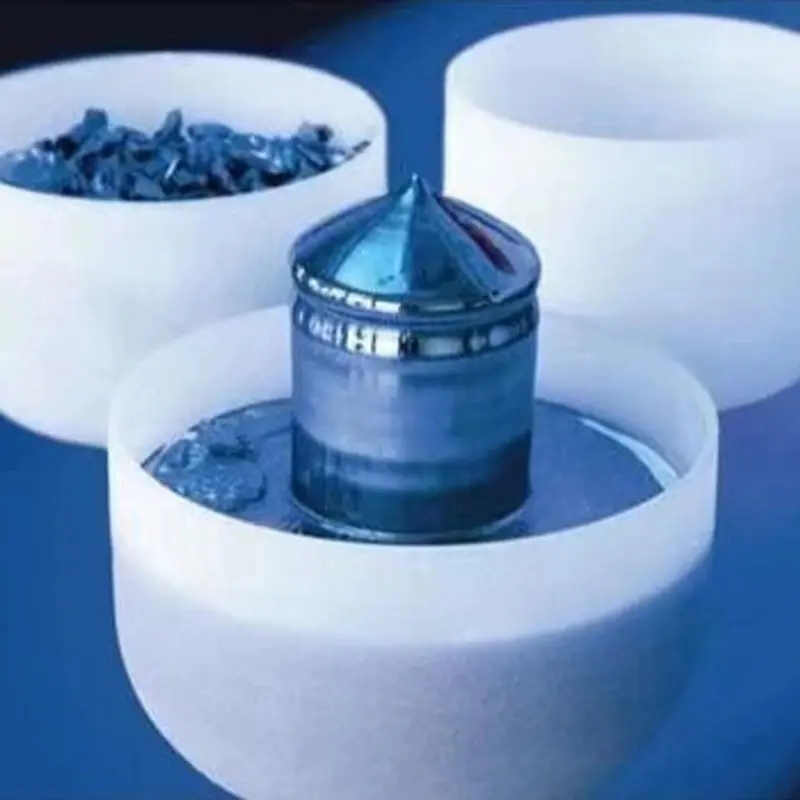
For silicon Czochralski (CZ) processes, synthetic-grade crucibles with metallic impurity levels below 1 ppm total are mandatory. Using standard-grade material introduces iron, aluminum, and calcium contamination directly into the melt, degrading minority carrier lifetime and device yield.
Control Thermal Gradients to Prevent Cracking
Quartz has a very low coefficient of thermal expansion (~0.55 × 10⁻⁶/°C), but it is brittle. Rapid temperature changes create steep internal stress gradients that exceed the material's modulus of rupture (~50 MPa), causing cracking or catastrophic fracture.
Recommended Heating and Cooling Ramp Rates
- Below 200 °C: ramp at no more than 10 °C/min — surface moisture and adsorbed gases must escape gradually.
- 200 °C to 600 °C: limit to 5 °C/min — this range crosses the α–β cristobalite transition zone where volume changes are significant.
- 600 °C to process temperature: 3–5 °C/min is typical for large crucibles (diameter > 300 mm).
- Cooling: always follow a controlled descent; quenching from above 800 °C causes irreversible micro-fractures even without visible cracking.
In CZ silicon growth, a common practice is to hold the crucible at 900 °C for 30–60 minutes during the initial ramp to equilibrate temperature across the wall thickness before raising to the silicon melting point (1,414 °C).
Minimize Devitrification to Extend Service Life
Devitrification—the transformation of amorphous silica into crystalline cristobalite—begins at approximately 1,000 °C and accelerates above 1,200 °C. Once devitrification spreads across the inner wall, the crucible becomes mechanically unstable and must be replaced. It is the leading cause of shortened crucible life in high-temperature applications.
Devitrification Prevention Measures
- Minimize alkali metal contamination. Sodium and potassium ions act as nucleation catalysts. Even fingerprint residues containing sodium can initiate devitrification at the contact point.
- Use protective coatings. A thin coating of silicon nitride (Si₃N₄) or barium sulfate (BaSO₄) on the inner wall slows the crystallization front. In solar applications, BaSO₄ coatings have been shown to extend crucible life by 15–30%.
- Limit cumulative high-temperature exposure. Track total hours above 1,100 °C; most high-purity crucibles are rated for 100–200 hours at this range before devitrification becomes structurally significant.
- Operate under inert or reducing atmosphere. Oxygen-rich environments accelerate surface oxidation reactions that promote crystallite nucleation.
Implement Strict Contamination and Handling Protocols
Surface contamination not only triggers devitrification but also introduces impurities into sensitive melts. In semiconductor CZ processes, a single particle of iron silicide measuring 0.5 μm can generate enough iron contamination to reduce wafer minority carrier lifetime below acceptable limits in the adjacent crystal section.
Handling and Cleaning Best Practices
- Always handle crucibles with clean-room gloves (nitrile or polyethylene, metal-free) — never bare hands.
- Pre-clean new crucibles with a dilute HF solution (typically 2–5% HF for 10–15 minutes) followed by a thorough deionized water rinse to remove surface metallic oxides from manufacturing.
- Dry crucibles in a clean oven at 120 °C for at least 2 hours before use to remove adsorbed moisture, which can cause violent spattering during heat-up.
- Store in sealed, dust-free containers; even short exposure in a standard laboratory environment can deposit particulates that are difficult to remove after sintering onto the surface.
- Inspect inner surfaces under UV light before each use — organic residues fluoresce and indicate incomplete cleaning.
Optimize Crucible Loading and Fill Level
How a crucible is loaded directly affects thermal stress distribution and melt dynamics. Improper loading creates localized hot spots, uneven crystallization, and mechanical stress concentrations that shorten crucible life.
- Fill to no more than 80% of rated capacity. Overfilling increases hydrostatic pressure on the sidewalls at elevated temperature, where quartz softens above ~1,665 °C (the softening point). At 1,200 °C, creep deformation becomes measurable under sustained load.
- Load charge material uniformly. Placing a large polysilicon chunk on one side creates asymmetric heating during melt-down, generating bending moments in the crucible wall.
- Avoid direct contact between charge pieces and the crucible wall during loading. Impact during loading is a leading cause of sub-surface micro-cracks that only propagate once the crucible reaches process temperature.
- For rotation-assisted processes (e.g., CZ pulling), verify rotation concentricity. Even a 0.5 mm eccentricity in crucible rotation at 5–10 rpm introduces cyclic mechanical stresses that can fatigue the base over multiple runs.
Monitor and Replace Based on Measurable Indicators
Relying solely on visual inspection leads to either premature replacement (cost waste) or delayed replacement (process failure risk). Instead, combine multiple indicators to make data-driven decisions.
Replacement Decision Criteria
| Indicator | Measurement Method | Action Threshold |
|---|---|---|
| Wall thickness reduction | Ultrasonic gauge or caliper (post-cool) | > 20% reduction from new |
| Devitrification area | Visual + transmitted light inspection | Opaque zone covers > 30% of inner surface |
| Melt metal impurity trend | ICP-MS on tail-end melt samples | Fe or Al exceeds spec by 2× |
| Cumulative thermal cycles | Process log | Exceeds manufacturer's rated cycle count |
Implementing a crucible lifecycle log—tracking each run's peak temperature, duration, and post-run inspection result—typically reduces unexpected failures by 40–60% compared to time-based replacement alone, based on data from high-volume silicon ingot production operations.
Leverage Atmosphere and Pressure Control
The atmosphere surrounding the crucible during operation has a direct impact on both the crucible material and melt purity. Optimizing atmospheric conditions is a low-cost, high-impact lever often overlooked in standard operating procedures.
- Inert gas purging (argon or nitrogen): Flowing argon at 10–20 L/min through CZ furnaces reduces SiO evaporation from the melt surface, which would otherwise deposit on cooler furnace walls and re-contaminate the melt in subsequent cycles.
- Reduced pressure operation: Running at 20–50 mbar (vs. atmospheric) during CZ growth reduces CO partial pressure, suppressing carbon incorporation into the crystal without accelerating quartz dissolution.
- Avoid water vapor: Even 10 ppm H₂O in the furnace atmosphere measurably increases the OH content of the melt, which elevates oxygen donor formation in silicon wafers during subsequent low-temperature annealing steps.
Summary: A Practical Optimization Checklist
The following checklist consolidates the core actions described above into a repeatable pre-run and in-process protocol:
- Confirm crucible grade matches process temperature and purity requirements.
- Clean with dilute HF, rinse with deionized water, and dry at 120 °C for ≥ 2 hours.
- Inspect inner surface under UV light; reject crucibles showing residue or micro-cracks.
- Load charge uniformly to ≤ 80% capacity; avoid wall impact during loading.
- Ramp temperature per protocol: ≤ 5 °C/min through 200–600 °C transition zone; hold at 900 °C for thermal equilibration.
- Maintain inert gas flow and target furnace pressure throughout the run.
- Cool under controlled descent; never quench from above 800 °C.
- Log run data and inspect for devitrification, wall thinning, and contamination indicators before clearing for reuse.
Consistently applying these steps extends average crucible service life, reduces per-run material costs, and—most importantly—protects the quality of the product melt or crystal grown within it.
Featured Products
Copyright © Yancheng Mingyang Quartz Products Co., Ltd. All Rights Reserved.
Wholesale Quartz Products Manufacturer Quartz Glass Factory