

 +86-0515-86223369
  0
0 en
en English
 日本語
日本語 Español


If you need any help, please feel free to contact us
 Products & Solutions
Borosilicate Glass vs. Quartz Glass
Content
- 1 Composition: What Each Material Is Made Of
- 2 Temperature Resistance: A Wide Performance Gap
- 3 Optical Transmission: UV Access Is the Decisive Factor
- 4 Chemical Purity and Contamination Risk
- 5 Mechanical and Physical Properties
- 6 Typical Applications: Where Each Material Is Used
- 7 Workability and Manufacturing Considerations
- 8 How to Choose: A Practical Decision Guide
Borosilicate glass and quartz glass are not interchangeable — they serve fundamentally different performance tiers. Quartz glass outperforms borosilicate glass in maximum temperature resistance, chemical purity, and UV transmission, while borosilicate glass offers reliable performance for everyday laboratory, industrial, and consumer applications at a more accessible cost. If your application requires sustained exposure above 500°C, deep UV transparency, or semiconductor-grade purity, quartz glass is the correct choice. For standard lab glassware, piping systems, or optical components operating in the visible spectrum, borosilicate glass is more than sufficient.
Composition: What Each Material Is Made Of
Borosilicate glass is a multi-component glass made primarily of silicon dioxide (SiO₂), with the addition of 12–15% boron trioxide (B₂O₃), along with small amounts of aluminum oxide (Al₂O₃) and alkali metal oxides such as sodium or potassium oxide. The boron trioxide network modifier is what lowers the thermal expansion coefficient and improves resistance to thermal shock compared to ordinary soda-lime glass.
Quartz glass, also called fused silica or fused quartz depending on the feedstock, is composed of silicon dioxide at purities of 99.9% or higher. Natural quartz sand is used for standard grades, while synthetic quartz produced via flame hydrolysis or chemical vapor deposition achieves purities above 99.9999% SiO₂. This near-perfect chemical simplicity is the root cause of quartz glass's superior thermal and optical properties.
Temperature Resistance: A Wide Performance Gap
Thermal performance is the most critical differentiator between these two materials and directly determines their application boundaries.
| Property | Borosilicate Glass | Quartz Glass |
|---|---|---|
| Max continuous use temperature | ~450–500°C | ~1100–1200°C |
| Softening point | ~820°C | ~1665°C |
| Coefficient of thermal expansion (CTE) | ~3.3 × 10⁻⁶/°C | ~0.55 × 10⁻⁶/°C |
| Thermal shock resistance | Good (ΔT ~120°C) | Excellent (ΔT ~1000°C) |
Quartz glass's CTE of just 0.55 × 10⁻⁶/°C — roughly six times lower than borosilicate — means it expands and contracts far less under temperature cycling, which is why quartz components can be transferred directly from a high-temperature furnace into room-temperature environments without cracking.
Optical Transmission: UV Access Is the Decisive Factor
Both materials transmit visible light effectively, but their behavior diverges sharply in the ultraviolet (UV) range.
- Borosilicate glass transmits wavelengths roughly from 350 nm to 2500 nm, covering most of the visible and near-infrared spectrum. It is largely opaque below 300 nm, making it unsuitable for deep UV applications.
- Quartz glass (fused silica) transmits wavelengths from approximately 150 nm to 3500 nm. Synthetic grades can reach down to 160 nm, enabling applications in vacuum UV (VUV) lithography and UV sterilization at 254 nm.
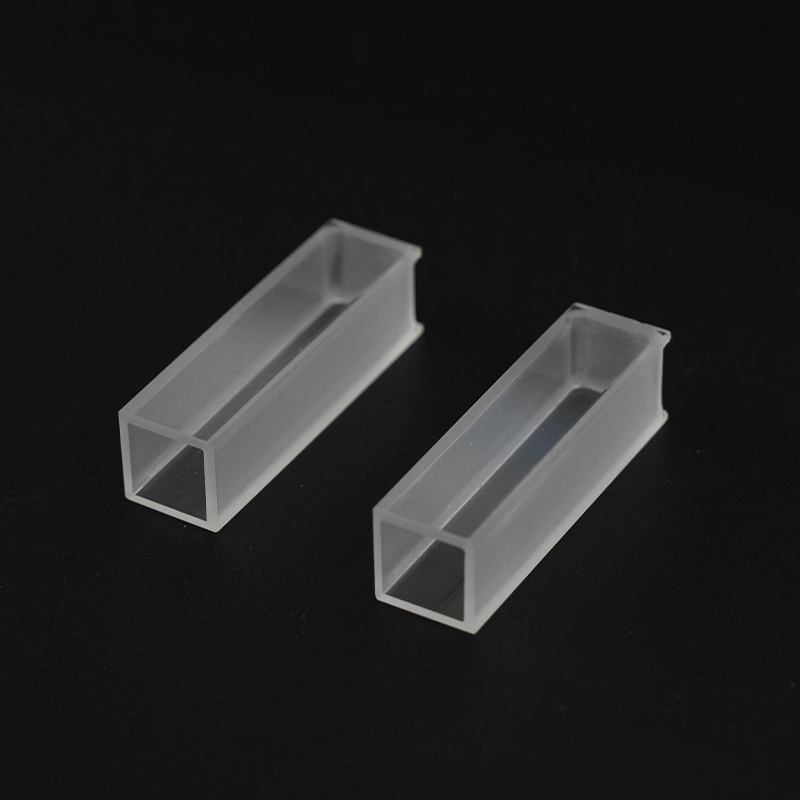
This UV transparency advantage makes quartz glass the standard material for UV spectrometer cells, excimer laser optics, UV curing systems, and germicidal lamp envelopes. Borosilicate glass simply absorbs the wavelengths these systems rely on.
Chemical Purity and Contamination Risk
The multi-component nature of borosilicate glass introduces trace elements — boron, sodium, aluminum, and potassium — that can leach into contents under prolonged exposure to aggressive chemicals or high temperatures. While leaching rates are very low in standard conditions, they become problematic in:
- Semiconductor wafer processing, where even parts-per-billion (ppb) metal contamination disrupts device performance
- High-purity analytical chemistry requiring blank values below detection limits
- Pharmaceutical manufacturing under stringent extractable and leachable (E&L) regulations
Quartz glass, being essentially pure SiO₂, introduces only silicon and oxygen into any contact medium. Synthetic fused silica grades used in semiconductor diffusion furnaces are specified with metallic impurities below 20 ppb total, which borosilicate glass cannot match.
Mechanical and Physical Properties
Outside of thermal and optical behavior, the two materials are reasonably comparable in everyday mechanical performance, though some differences are worth noting.
| Property | Borosilicate Glass | Quartz Glass |
|---|---|---|
| Density | ~2.23 g/cm³ | ~2.20 g/cm³ |
| Refractive index (at 589 nm) | ~1.473 | ~1.458 |
| Vickers hardness | ~480 HV | ~1050 HV |
| Dielectric constant | ~4.6 | ~3.75 |
Quartz glass's significantly higher hardness (~1050 HV versus ~480 HV) means quartz components resist surface scratching better over time, which is relevant in optical systems where surface quality directly affects performance. Its lower dielectric constant also makes it the preferred substrate material in high-frequency electronic applications.
Typical Applications: Where Each Material Is Used
Borosilicate Glass Applications
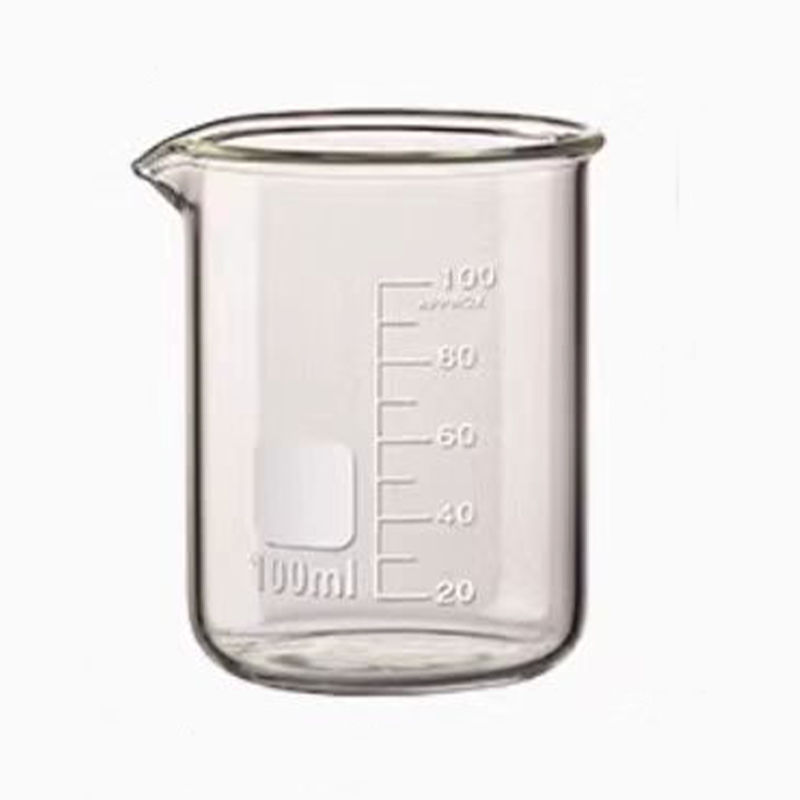
- Laboratory glassware: beakers, flasks, test tubes, condensers, and pipettes used in chemical and biological research
- Industrial sight glasses and piping for chemical processing plants operating below 450°C
- Pharmaceutical vials, ampoules, and cartridges where Type I borosilicate glass meets USP and EP standards for drug packaging
- Consumer cookware and bakeware designed to withstand oven temperatures and stovetop use
- Telescope mirror blanks and camera lenses in mid-range optical instruments
- Electrical insulation components in lighting and electronics
Quartz Glass Applications
- Semiconductor manufacturing: diffusion tubes, boat carriers, and process chambers in wafer fabrication where metal contamination must be kept below ppb levels
- UV lamp envelopes for germicidal, excimer, and mercury arc lamps transmitting at 185 nm and 254 nm
- High-precision optical lenses, prisms, and windows for UV and deep UV lithography systems
- High-temperature furnace tubes and crucibles for metal, ceramic, and crystal growth processes
- Fiber optic preforms as the base material for telecommunications-grade optical fiber
- Space telescope mirrors and satellite optical systems requiring zero thermal distortion across extreme temperature swings
Workability and Manufacturing Considerations
Borosilicate glass has a relatively low working temperature of around 820°C and can be shaped, blown, and fused using standard glassblowing equipment. This makes custom fabrication of laboratory glassware and industrial components straightforward, and the material is widely available in tubing, rod, and sheet forms.
Quartz glass requires working temperatures above 1600°C, which demands specialized oxyhydrogen or plasma torches and skilled operators. Fusing, shaping, and welding quartz is a more demanding process that takes longer and requires more energy. Complex geometries in quartz are therefore more difficult to produce and lead times for custom quartz components are typically longer than for borosilicate equivalents.
From a machining standpoint, quartz glass's higher hardness (around 1050 HV) means it requires diamond-tipped or abrasive tooling, increasing processing time compared to the softer borosilicate. However, this same hardness yields better dimensional stability in finished quartz components under abrasive or high-load conditions.
How to Choose: A Practical Decision Guide
Use the following criteria to determine which material fits your application:
- Operating temperature above 500°C: Quartz glass is required. Borosilicate will soften and deform.
- UV wavelengths below 300 nm: Quartz glass only. Borosilicate blocks these wavelengths.
- Semiconductor or ultra-high-purity process: Synthetic quartz with verified metallic impurity specifications is mandatory.
- Standard laboratory or pharmaceutical use: Type I borosilicate glass fully meets ISO and pharmacopeial requirements at lower cost and easier availability.
- Visible-spectrum optics: Either material works; borosilicate is adequate and easier to source for most mid-range optical components.
- Extreme thermal cycling: Quartz glass, with its CTE six times lower than borosilicate, handles rapid temperature changes with significantly less risk of cracking.
The bottom line: specify quartz glass when temperature, purity, or UV transmission push beyond what borosilicate can deliver. In all other cases, borosilicate glass is a robust, cost-effective, and widely available solution that has served scientific and industrial applications reliably for over a century.
Featured Products
Copyright © Yancheng Mingyang Quartz Products Co., Ltd. All Rights Reserved.
Wholesale Quartz Products Manufacturer Quartz Glass Factory