

 +86-0515-86223369
  0
0 en
en English
 日本語
日本語 Español


If you need any help, please feel free to contact us
 Products & Solutions
Can Quartz Glass Tubes Resist Chemical Corrosion?
Content
- 1 What Makes Fused Quartz Chemically Resistant?
- 2 Key Chemical Resistance Data Across Acid Types
- 3 Temperature Performance: The High-Temperature Advantage of Quartz Tubing
- 4 UV Quartz Tube and Optical Transparency: Applications Beyond Chemistry
- 5 Industrial Applications: Where Quartz Tubing Performs Best
- 6 Manufacturing Methods: How Quartz Tubes Are Produced
- 7 Quartz Tube Grades and Product Range at Mingyang
- 8 Selecting the Right Quartz Tube: A Buyer's Checklist
- 9 About Yancheng Mingyang Quartz Products Co., Ltd.
- 10 Frequently Asked Questions
Yes — quartz glass tubes offer outstanding chemical resistance, particularly against most acids, oxidizing agents, and reactive gases at both ambient and elevated temperatures. Unlike standard borosilicate or soda-lime glass, a quartz glass tube is composed of high-purity silicon dioxide (SiO₂, typically >99.9%), which gives it a near-inert surface that repels attack from hydrochloric acid, sulfuric acid, nitric acid, and most organic solvents. This makes quartz glass tubing a trusted material in semiconductor fabrication, pharmaceutical manufacturing, chemical processing, and laboratory analysis. However, chemical resistance is not absolute: hydrofluoric acid (HF) and hot alkalis such as sodium hydroxide (NaOH) can etch or dissolve fused silica surfaces over time. Understanding where these limits fall is essential before specifying a quartz tube for any critical application.
This guide examines the science behind chemical corrosion resistance in fused quartz and fused silica tube products, compares performance data across common corrosive environments, and explains how Yancheng Mingyang Quartz Products Co., Ltd. engineers tubes to meet demanding industrial and optical specifications.
What Makes Fused Quartz Chemically Resistant?
The exceptional chemical resistance of a fused silica tube originates in its molecular architecture. Fused quartz consists of an amorphous, three-dimensional network of SiO₄ tetrahedra, with each silicon atom covalently bonded to four oxygen atoms. This dense, cross-linked network leaves very few reactive surface sites exposed to aggressive chemicals. Because the Si–O bond energy is approximately 452 kJ/mol — significantly higher than bonds in most other glass systems — it requires substantial activation energy to break down the silica matrix.
In practice, this means that common mineral acids — including hydrochloric acid (HCl), sulfuric acid (H₂SO₄), nitric acid (HNO₃), and phosphoric acid (H₃PO₄) — barely attack a high temperature quartz tube even at elevated concentrations and temperatures. The rate of corrosion is measured in microns per year under most laboratory conditions. Comparatively, borosilicate glass corrodes two to five times faster under the same exposure conditions, while standard soda-lime glass corrodes up to twenty times faster.
The purity of the raw silica used in manufacturing also matters significantly. A transparent quartz tube made from natural quartz crystal or synthetic silica with metallic impurities below 5 ppm maintains chemical inertness far longer than lower-grade alternatives. Contaminants such as iron, aluminum, or calcium oxide create structural defects in the glass network that serve as preferential corrosion sites.
The horizontal bar chart above quantifies corrosion rates across common tube materials exposed to 80°C sulfuric acid. Fused quartz registers just 0.8 μm/year, making it the most inert option by a wide margin. Borosilicate glass — widely regarded as chemical-resistant — corrodes more than five times faster at 4.2 μm/year. Aluminosilicate and soda-lime glasses show progressively higher attack rates, with soda-lime reaching 16 μm/year, which would noticeably degrade a thin-walled tube within months of service. Even austenitic stainless steel (316SS), commonly selected for corrosive environments, corrodes at 12 μm/year under these conditions. The data reinforce why industries handling hot acids — including semiconductor wet benches, chemical synthesis reactors, and pharmaceutical glass pipework — consistently specify quartz glass tubing or fused silica tube over all alternatives. For engineers selecting a quartz glass tubing supplier, requesting material certification with SiO₂ purity data is a reliable way to verify tube quality before procurement.
Key Chemical Resistance Data Across Acid Types
Different acids attack silica through different mechanisms, and the resistance profile of a quartz pipe or glass pipe varies considerably across the pH spectrum. The table below summarizes laboratory-measured corrosion rates for high-purity fused quartz immersed in various reagents at 25°C and 100°C over a 30-day test period. These benchmarks are widely referenced in semiconductor process engineering and laboratory glassware specifications.
| Reagent | Concentration | 25°C Rate | 100°C Rate | Risk Level |
|---|---|---|---|---|
| HCl (Hydrochloric Acid) | 37% | <0.1 μm/yr | 0.4 μm/yr | Low |
| H₂SO₄ (Sulfuric Acid) | 96% | <0.1 μm/yr | 0.8 μm/yr | Low |
| HNO₃ (Nitric Acid) | 65% | <0.1 μm/yr | 0.3 μm/yr | Low |
| HF (Hydrofluoric Acid) | 40% | ~1,200 μm/yr | >10,000 μm/yr | Critical |
| NaOH (Sodium Hydroxide) | 30% | 18 μm/yr | 320 μm/yr | High |
| H₃PO₄ (Phosphoric Acid) | 85% | 0.5 μm/yr | 3.2 μm/yr | Low–Moderate |
| Water (DI) | 100% | <0.01 μm/yr | 0.02 μm/yr | Negligible |
The data highlights a critical pattern: virtually all strong mineral acids leave fused quartz rods, tubes, and vessels practically unaffected at room temperature. The extraordinary exception is hydrofluoric acid, which attacks the Si–O network directly by converting SiO₂ into soluble SiF₄, producing corrosion rates tens of thousands of times higher than any other common acid. Hot alkalis are also problematic because hydroxide ions (OH⁻) break Si–O–Si bonds through nucleophilic attack, with the rate increasing sharply with both temperature and concentration. Engineers must evaluate the full operating envelope — not just the reagent type, but also its temperature and contact duration — when selecting quartz tubing for chemical service.
Temperature Performance: The High-Temperature Advantage of Quartz Tubing
One of the most compelling reasons to choose a high temperature quartz tube over alternative glass or ceramic materials is the combination of thermal stability and chemical inertness that persists at extreme temperatures. Fused quartz maintains structural integrity to approximately 1,650°C in short-term service and can be used continuously at temperatures up to 1,100°C. By comparison, borosilicate glass softens near 820°C and aluminosilicate glass near 900°C. This 200–750°C gap in working temperature is significant for industries such as semiconductor diffusion furnaces, optical fiber drawing towers, and thermal processing equipment — all of which rely on quartz tube furnace designs.
The low coefficient of thermal expansion (CTE) of fused silica — approximately 0.54 × 10⁻⁶/°C, compared to 3.3 × 10⁻⁶/°C for borosilicate glass — means that quartz tubes can be rapidly heated or quenched without fracturing. This thermal shock resistance is critical in quartz tube furnace applications where tubes cycle between room temperature and operating temperature many times per day. In chemical processing contexts, hot acid introduction into a preheated tube is far safer when the tube material exhibits low thermal expansion.
The line chart demonstrates a critical divergence in chemical resistance behavior at elevated temperatures. At room temperature (25°C), both fused quartz and borosilicate glass exhibit relatively low corrosion rates in 20% HCl; the difference is modest. However, as temperature climbs above 200°C, the corrosion rate of borosilicate glass accelerates steeply — more than doubling with every 200°C increase — while fused quartz maintains a gradual, nearly linear progression. By 800°C, borosilicate glass has reached critical corrosion levels that render it impractical for sustained use, while a high temperature quartz tube continues to function reliably. This behavior stems from the fact that borosilicate glass contains boron oxide (B₂O₃) and alkali fluxes that dissolve preferentially under acidic hot conditions. Pure fused silica contains no such secondary phases. For processes such as chemical vapor deposition (CVD), thermal oxidation of silicon wafers, or high-temperature gas chromatography, this performance gap is not merely academic — it directly determines whether a tube survives its rated service life. A properly specified quartz tube furnace environment using high-purity fused quartz tubing will outlast borosilicate alternatives by a factor of three to eight times in similar thermal-chemical environments.
UV Quartz Tube and Optical Transparency: Applications Beyond Chemistry
A UV quartz tube differs from standard transparent quartz in its hydroxyl (OH) content and purity levels, which together determine ultraviolet transmission characteristics. Standard fused silica shows excellent transmission from approximately 150 nm to 3,500 nm, spanning the UV-C, UV-B, UV-A, visible, and near-infrared ranges. By contrast, borosilicate glass begins absorbing strongly below 300 nm, blocking the UV-C range entirely. This makes UV quartz tube products indispensable in applications such as germicidal lamp sleeves, photochemical reactors, water sterilization systems, and UV-curing equipment.
The low-hydroxyl (low-OH) variant — also called dehydroxylation quartz — suppresses the OH absorption peaks near 1,380 nm and 2,730 nm that would otherwise cause signal attenuation in certain optical fiber and laser applications. A dehydroxylated fused silica tube with OH content below 5 ppm is specified for high-pressure mercury lamps, sodium discharge lamps, and gold halide lamp envelopes, where the tube must be transparent to both UV and visible radiation while surviving temperatures above 900°C. Optical transmittance of more than 93% across the visible spectrum is achievable in high-purity transparent tubes, meeting the stringent demands of spectrophotometry and optical research.
The column chart above illustrates a stark divide in ultraviolet transparency at 250 nm — a wavelength critical for germicidal and photochemical applications. A UV quartz tube achieves 93% transmittance, while low-OH fused silica reaches 91% and standard fused silica 85%. Beyond fused silica, transmission drops off sharply: borosilicate glass manages only 8%, and soda-lime glass is virtually opaque at UV wavelengths below 300 nm. This data explains why UV water purification systems, laboratory photoreactors, and excimer laser optics are built exclusively around quartz glass, not borosilicate or ordinary glass. The transmittance advantage also extends to far-infrared wavelengths when opaque or translucent grades are used — the translucent quartz tube (such as MQ-R100 series products) allows efficient passage of infrared radiation while blocking visible light, making it ideal for electric heaters and infrared lamp applications. For engineers specifying materials for optical instruments, the transmittance profile of a fused silica tube is often the primary selection criterion, ranking ahead of mechanical strength or even chemical resistance. Understanding these optical properties helps buyers work more effectively with a quartz glass tubing supplier to match the right tube grade to their application.
Industrial Applications: Where Quartz Tubing Performs Best
The combined properties of chemical inertness, thermal stability, UV transparency, and low thermal expansion make quartz glass tubing and fused quartz components essential across an unusually broad range of industries. The following categories represent the highest-volume and most demanding application environments, where no alternative material provides equivalent performance.
Semiconductor Fabrication
Semiconductor diffusion and oxidation furnaces use quartz tube furnace configurations with large-diameter high-purity quartz tubes — commonly 150 mm to 300 mm inner diameter — to process silicon wafers at temperatures from 800°C to 1,200°C in precisely controlled atmospheres of oxygen, nitrogen, or reactive gases. Any metallic contamination from the tube material would catastrophically dope the silicon substrate, making the ultra-low metallic impurity content of fused quartz (typically Fe, Al, and Na below 1 ppm each) a hard requirement. Custom quartz tubing for this sector requires traceable purity certificates and dimensional tolerances of ±0.5 mm on inner diameter.
Lighting and Heating
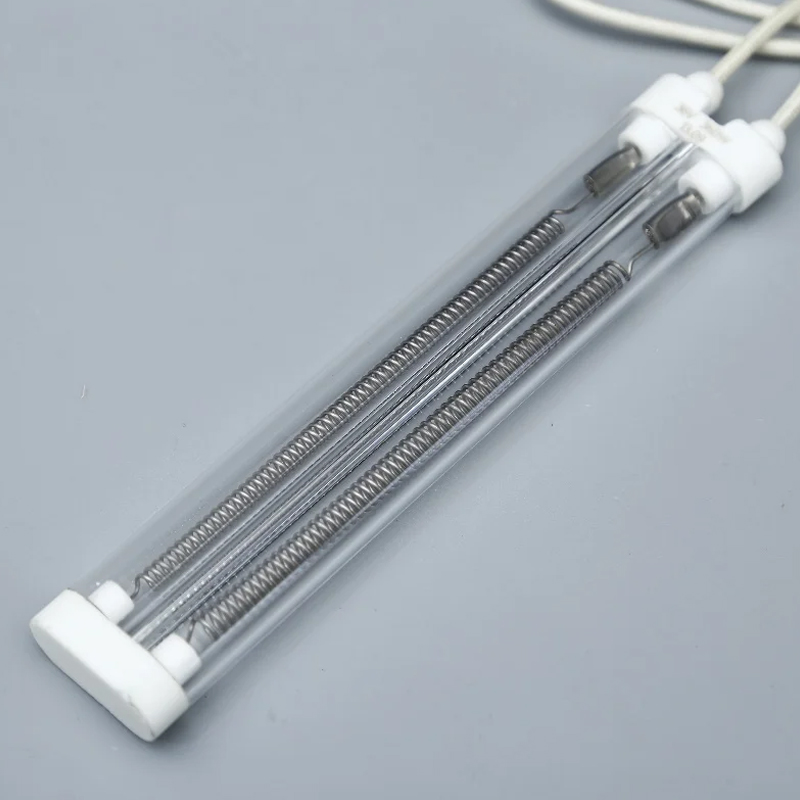
Halogen lamps, high-pressure sodium lamps, and metal halide lamps all use quartz glass tube envelopes because ordinary glass would soften and deform at the internal operating temperatures of 600–900°C. Infrared heating applications similarly rely on translucent or opaque quartz tubes to house tungsten heating elements or carbon fiber elements, directing thermal energy efficiently via infrared radiation. These tubes must withstand rapid thermal cycling, resist discoloration from halogen gas interaction, and maintain dimensional accuracy over thousands of operating cycles.
Chemical and Pharmaceutical Processing
Flow reactors, heat exchangers, and sample transport lines in aggressive acid environments rely on quartz pipe and tube assemblies where metal or polymer alternatives would either corrode too quickly or introduce trace contamination. A glass pipe made from fused silica also allows visual monitoring of flow and reaction progress, a feature unavailable with metal piping. Pharmaceutical manufacturers also use quartz tubes in sterile process environments because fused silica does not leach ions into high-purity water or drug solutions.
The radar chart above plots six critical performance dimensions for fused quartz against borosilicate glass, scored on a 0–100 scale based on material benchmarks. Fused quartz (solid blue polygon) commands the outer edge of nearly every axis, scoring 93–98% across chemical resistance, thermal stability, purity, and thermal shock resistance. Borosilicate glass (dashed polygon) performs reasonably in dimensional accuracy and moderately in chemical resistance but drops sharply on UV transmission (8 vs 93) and thermal stability. The most visually striking gap is UV transmission, where the two materials are not even remotely comparable. This radar visualization explains why industries with multi-factor requirements — pharmaceutical reactors that need both chemical inertness and UV sterilization capability, or semiconductor furnaces that need both ultra-high purity and thermal stability — converge on fused quartz as the only viable material. For companies evaluating custom quartz tubing procurement decisions, a radar comparison like this provides a rigorous framework for justifying the material upgrade from borosilicate to fused silica.
Manufacturing Methods: How Quartz Tubes Are Produced
The method by which a quartz glass tube is manufactured directly affects its purity, dimensional tolerance, OH content, bubble density, and surface quality. There are two primary production routes used by leading manufacturers.
- Melting-type drawing (continuous drawing): Natural quartz crystal or synthetic silica sand is melted in a high-purity furnace and continuously drawn into tubes through a die. This process produces transparent quartz tubes with tightly controlled OD, ID, and wall thickness, and is suited for high-volume production of standard tube dimensions including common glass pipe and tube products. The drawing speed and temperature profile govern surface smoothness and residual stress levels.
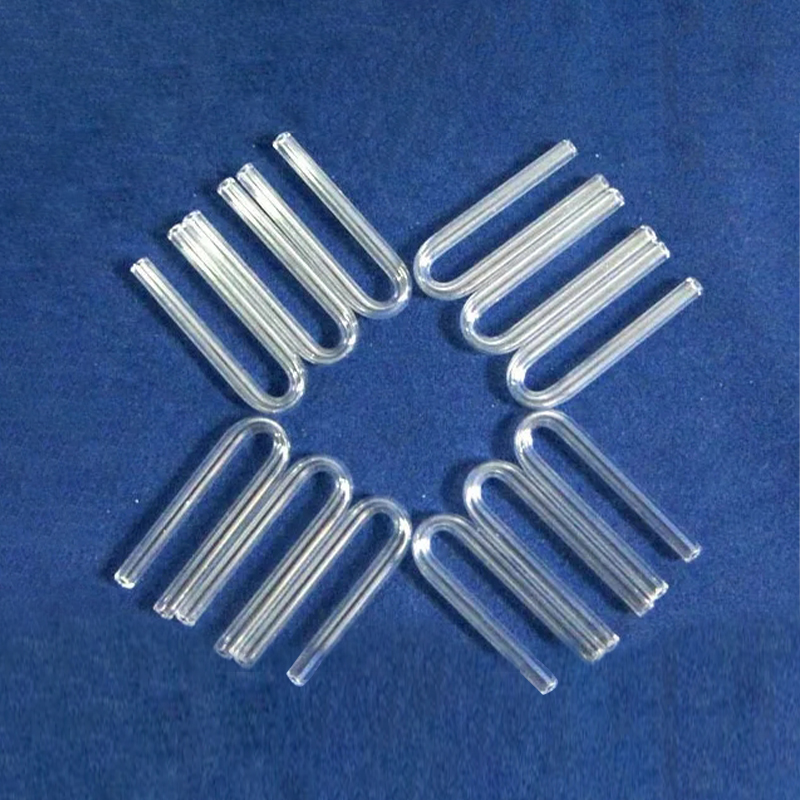
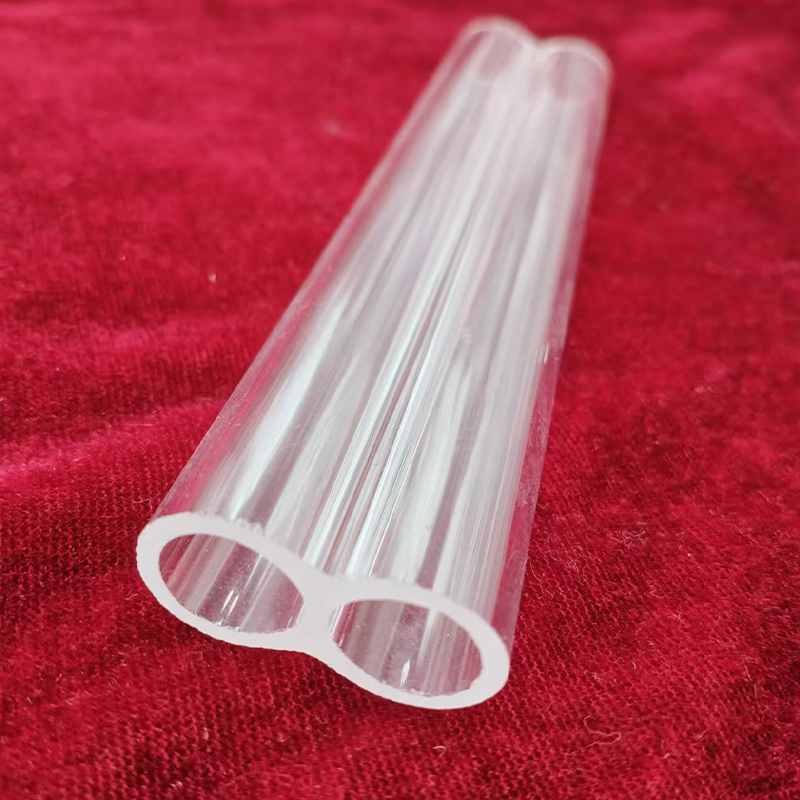
- Processing forming (lathe-based): Starting from large-diameter fused silica billets or tubes, secondary processing by glass-working lathes creates custom shapes — bent quartz tubes, spherical quartz tubes, flanged tubes, and shaped quartz tubing with non-standard profiles. This method enables the production of double-hole quartz glass tubes, shaped reactor vessels, and specialty components unavailable through continuous drawing alone.
Following forming, tubes destined for lamp and UV applications undergo baking treatments to control OH content. Standard-OH tubes contain approximately 150–300 ppm hydroxyl; low-OH dehydroxylated grades bring this below 10 ppm, with vacuum dehydroxylation achieving below 5 ppm. These controlled hydroxyl levels are critical for applications such as high-pressure mercury lamps, sodium lamps, and halide lamps, where the OH content affects both spectral output and service lifetime. For custom quartz tubing orders, specifying the required OH range upfront with the quartz glass tubing supplier ensures the correct process route is selected from the outset.
Quartz Tube Grades and Product Range at Mingyang
Yancheng Mingyang Quartz Products Co., Ltd. — the Jiangsu production facility of Jinzhou Mingde Quartz Glass Co., Ltd. — manufactures a comprehensive range of quartz glass tube grades and related products. Since establishment, the company has continuously integrated advanced technology and production equipment from both domestic and international sources to meet the evolving requirements of semiconductor, optical, chemical, and heating industries.
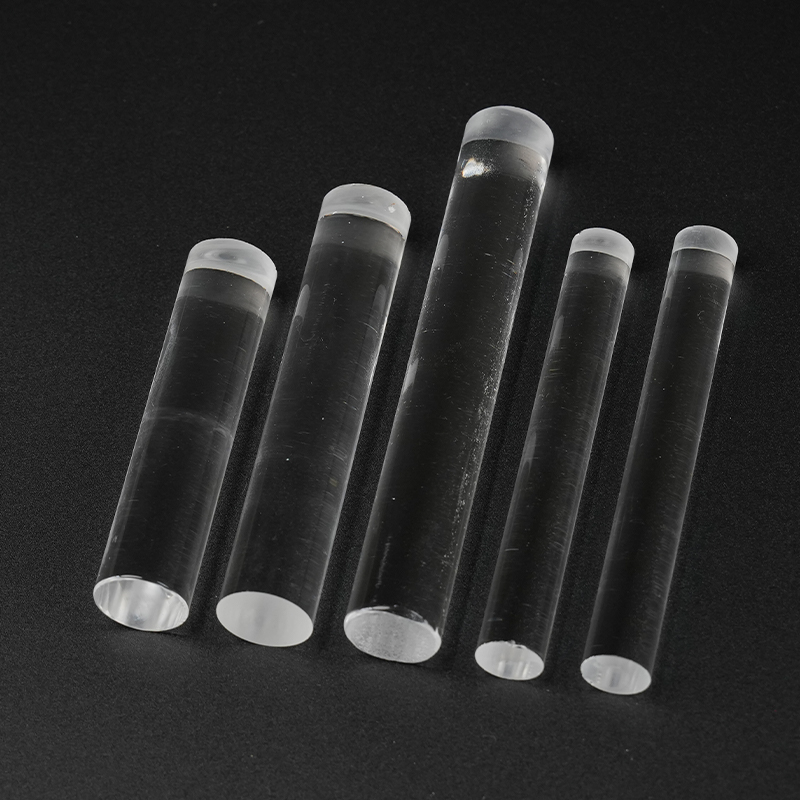
The product portfolio extends well beyond standard tubes. Mingyang produces quartz glass rods, quartz sheets, quartz glass windows, sapphire windows, calcium fluoride glass windows, infrared and ultraviolet coatings, high-pressure resistant aluminosilicate glass window panels, and a full range of quartz glass instruments. For laboratory and industrial processes, the company supplies quartz crucibles, clear quartz crucibles, high-purity silica crucibles, and laboratory quartz crucibles suited to high-temperature metal melting and semiconductor crystal growth. The heating product line includes quartz heaters, quartz infrared heating tubes, far-infrared directional radiation heaters, and ultraviolet germicidal lamps. Decorative and functional acoustic products including quartz-derived components for sound healing instruments and specialty glass further demonstrate the versatility of Mingyang's silica-based manufacturing capabilities.
The bar chart illustrates the approximate distribution of Yancheng Mingyang's product portfolio across five major application segments. Tubes and rods account for the largest share at 35%, reflecting the foundational importance of quartz glass tube, quartz tubing, double-hole tubes, and quartz crystal rods and quartz glass rods in the company's core output. Heating products represent 22% of the range, covering quartz infrared heating tubes, carbon fiber quartz heaters, and far-infrared directional heaters — a rapidly growing category driven by industrial energy efficiency initiatives. Crucibles and instruments at 20% include laboratory quartz crucibles, silica crucibles, high-borosilicate glass instruments, and process vessels. The optical and windows segment at 15% encompasses quartz glass windows, UV plates, sapphire windows, and coated optical components. The specialty and custom category at 8% covers unique customer-driven solutions such as gold-plated quartz tubes, custom bent or shaped tubes, and engineered assemblies for specific process environments. This breadth of capability enables Mingyang to serve as a single-source quartz glass tubing supplier across multiple product categories, reducing procurement complexity for customers managing diverse glass and quartz component needs.
Selecting the Right Quartz Tube: A Buyer's Checklist
Specifying the correct quartz glass tubing requires evaluating several parameters systematically. Using the wrong grade can lead to premature failure, contamination, or inadequate optical or thermal performance. The checklist below covers the most critical decision points for industrial and laboratory buyers.
- Operating temperature: For continuous use above 800°C, specify fused quartz or fused silica. For intermittent peaks above 1,000°C, confirm the tube's strain point and softening point from the supplier's datasheet. Standard transparent quartz tubes have a softening point near 1,665°C.
- Chemical environment: For HF or concentrated alkali service above 100°C, fused quartz is not suitable and alternative materials such as PTFE-lined vessels should be considered. For all other mineral acid and oxidizing environments, fused quartz is the preferred choice.
- OH content and optical requirements: If UV transmission below 250 nm is required, specify low-OH (below 10 ppm) or synthetic UV-grade fused silica. For standard thermal or chemical service without UV requirements, standard-OH grades are sufficient and more economical.
- Purity grade: Semiconductor and pharmaceutical applications require metallic impurity certification. Request SiO₂ purity data (typically >99.9%) and specific trace element analysis for Fe, Al, Ca, Na, Mg, and Ti.
- Dimensional tolerances: Precision tube furnace fittings typically require OD tolerances of ±0.5 mm and wall thickness tolerances of ±0.2 mm. Confirm that the quartz glass tubing supplier can certify dimensional compliance per batch.
- Custom forming requirements: If standard straight tubes are insufficient, evaluate bent quartz tubes, flanged ends, shaped quartz tubing, or double-hole designs with your manufacturer. Not all suppliers have lathe-forming capability for custom quartz tubing.
About Yancheng Mingyang Quartz Products Co., Ltd.
Yancheng Mingyang Quartz Products Co., Ltd. is a company specializing in the production of quartz and special glass products, serving as the Jiangsu manufacturing base of Jinzhou Mingde Quartz Glass Co., Ltd. Since establishment, the company has developed rapidly by introducing advanced technology and production equipment from both domestic and international sources, continuously improving product quality and expanding its portfolio.
Relying on its own manufacturing strengths, Mingyang has developed a diverse range of products tailored to specific market needs and customer requirements, solving many urgent production challenges across industries. The company's product range includes quartz glass tubes, double-hole quartz glass tubes, quartz glass rods, quartz sheets, sapphire windows, calcium fluoride glass windows, infrared and ultraviolet coatings, high-pressure resistant aluminosilicate glass windows, quartz glass instruments, high borosilicate glass instruments, quartz crucibles, quartz gold-plated tubes, quartz heaters, quartz infrared heating tubes, far-infrared directional radiation heaters, ultraviolet germicidal lamps, and a broad range of other special-purpose quartz glass products. With this comprehensive capability, Mingyang is positioned to support engineers, researchers, and manufacturers who require reliable, well-specified quartz products across optical, thermal, chemical, and acoustic applications.
Frequently Asked Questions
Featured Products
Copyright © Yancheng Mingyang Quartz Products Co., Ltd. All Rights Reserved.
Wholesale Quartz Products Manufacturer Quartz Glass Factory