

 +86-0515-86223369
  0
0 en
en English
 日本語
日本語 Español


If you need any help, please feel free to contact us
 Products & Solutions
Quartz Tube vs Borosilicate Glass Tube: Which Is Better?
Content
- 1 Head-to-Head Property Comparison: Nine Technical Criteria
- 2 Temperature Performance: The Most Critical Differentiator
- 3 UV and IR Transmission: Where Quartz Is Irreplaceable
- 4 Multi-Axis Performance Radar: Eight Criteria Simultaneously
- 5 Application Decision Matrix: When to Choose Each Material
- 6 Extended Application Coverage: Sound Healing, Optical, and Specialty Products
- 7 About Yancheng Mingyang Quartz Products Co., Ltd.
- 8 Frequently Asked Questions
The direct answer: fused quartz tube wins on every technical performance dimension — temperature resistance, UV transmission, thermal shock resistance, chemical purity, and dimensional stability — while borosilicate glass tube offers a more accessible entry point for moderate-temperature laboratory and foodservice applications. For high temperature quartz tube applications above 500°C, semiconductor processing, UV lamp envelopes, or quartz tube furnace use, there is no practical borosilicate substitute. For standard laboratory glassware — high borosilicate measuring cup, triangular shaped funnel, triangular flask chemistry, or bell glass dome — borosilicate remains cost-effective and appropriate. The choice between the two materials is therefore driven by operating temperature, spectral requirements, and chemical environment, not a single universal ranking.
This article provides a structured property-by-property comparison across nine technical criteria, supported by data visualizations, to help engineers, procurement managers, and laboratory professionals make the correct material selection for their specific application — whether that is a glass pipe for chemical transfer, a quartz tube for a semiconductor furnace, a UV quartz tube for a germicidal lamp, or a heat-resistant glass tube for an industrial heater assembly.
Head-to-Head Property Comparison: Nine Technical Criteria
The table below compares fused quartz (SiO2 content above 99.9%) against standard borosilicate glass (Type 3.3, 80–81% SiO2) across the nine criteria most relevant to industrial and scientific tube selection. Data is drawn from published material property databases including ASTM C1036, ISO 4802, and manufacturer technical datasheets.
| Property | Fused Quartz / Silica Tube | Borosilicate Glass Tube (3.3) | Better Choice |
|---|---|---|---|
| Max Continuous Use Temp. | 1100°C (short-term 1300°C) | 500°C | Quartz |
| Thermal Expansion Coeff. | 0.54 x 10⁻⁶ /°C | 3.3 x 10⁻⁶ /°C | Quartz |
| Thermal Shock Resistance | Above 1000°C delta T | Approx. 170°C delta T | Quartz |
| UV Transmission (254nm) | Above 85% | Below 5% | Quartz |
| Visible Transmittance | Above 93% | Above 91% | Similar |
| Acid Resistance | Excellent (except HF, hot H3PO4) | Good (HF and strong alkali attack) | Quartz |
| Alkali Resistance | Moderate (NaOH attacks above 100°C) | Poor (alkalis dissolve borosilicate) | Quartz |
| SiO2 Purity | Above 99.9% | 80–81% | Quartz |
| Machinability / Formability | Moderate (requires specialist equipment) | Good (standard glass working) | Borosilicate |
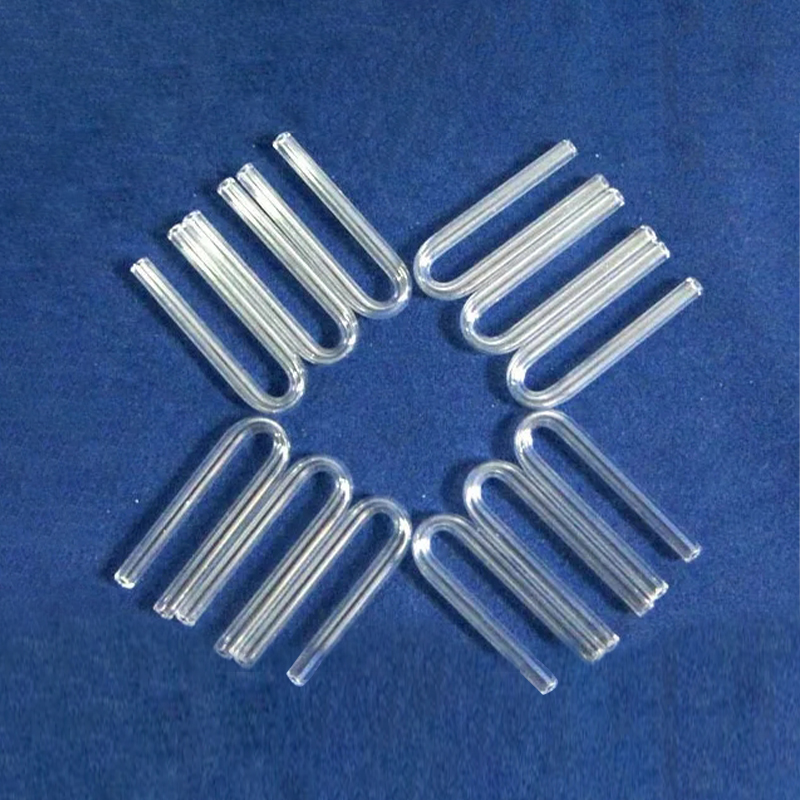
The table shows that fused quartz outperforms borosilicate glass on eight of nine criteria. The sole exception is machinability and formability, where borosilicate's lower softening point (approximately 820°C vs. 1665°C for quartz) allows it to be flame-worked and formed with standard laboratory glass-blowing equipment, whereas quartz requires specialist high-temperature torch or furnace processing. For standard-shaped products — straight tubes, U-bends, simple vessels — this advantage is largely offset by Yancheng Mingyang's CNC-driven secondary processing capability for quartz, which covers bending, welding, and special-shaped forming.
Temperature Performance: The Most Critical Differentiator
The maximum continuous operating temperature of 1100°C for fused quartz tube versus 500°C for borosilicate is not a marginal difference — it is a factor of more than 2x that determines whether a material can physically function in the application. The 3D column chart below shows the softening points, continuous use limits, and short-term maximum temperatures for both materials alongside the operating requirements of key application categories.
The 3D column chart makes the temperature capability gap visually clear: the softening point of fused quartz (1665°C) is more than twice that of borosilicate glass (820°C), and the continuous use limit of fused quartz (1100°C) exceeds borosilicate's softening point entirely. This means that at temperatures where borosilicate glass begins to deform and lose structural integrity, high temperature quartz tube is still operating well within its safe working range. For semiconductor diffusion furnace applications requiring 900–1100°C process temperatures, quartz is the only viable glass tube material — borosilicate cannot be considered. The chemical reactor range (200–600°C) sits at an interesting crossover: at the lower end, borosilicate may suffice for modest-temperature acid handling; at 500°C and above, only quartz maintains safe structural margins. Only standard laboratory glassware (up to approximately 200°C) falls comfortably within the borosilicate safe operating range, which is why products like high borosilicate measuring cup, triangular flask chemistry, and heat-resistant glass tube for moderate-temperature lab use are appropriately made from borosilicate glass rather than quartz.
UV and IR Transmission: Where Quartz Is Irreplaceable
For any application involving ultraviolet or near-ultraviolet wavelengths, fused silica tube or UV quartz tube is not merely preferable — it is functionally irreplaceable. Standard borosilicate glass absorbs virtually all radiation below 300nm, making it opaque to UV-C (100–280nm) and UV-B (280–315nm). The line chart below shows the transmission curves for both materials across the UV-visible-near-IR spectrum from 200nm to 2500nm.
The transmission spectra chart shows the decisive advantage of fused quartz in the UV range with striking clarity. At 254nm (the primary emission line of low-pressure mercury germicidal lamps), fused quartz transmits approximately 85% of UV radiation, while borosilicate glass transmits under 5% — making borosilicate essentially opaque to germicidal UV and completely unsuitable for UV lamp envelopes, UV Fused Quartz Cuvettes, UV Quartz Plate applications, or any UV Round Quartz Plate With Holes used in photolithography stages. In the visible and near-infrared range (400–1000nm), both materials perform similarly with transmittance above 90%, which is why borosilicate is adequate for standard laboratory spectrophotometry at visible wavelengths. In the mid-IR range (above 2000nm), both materials show declining transmittance due to SiO2 network absorption bands — for far-IR applications, milky (opaque) quartz glass tube or specialized infrared-transmitting materials are selected instead. The UV transmission advantage of quartz glass makes it the only viable material for light-curing equipment envelopes, sterilization lamp tubes, UV LED packaging components, and quartz glass window panels used in UV processing chambers. Applications that rely on borosilicate glass for these purposes will receive negligible UV output regardless of lamp power.
Multi-Axis Performance Radar: Eight Criteria Simultaneously
The radar chart below provides a simultaneous view of both materials across eight performance dimensions, allowing engineers to quickly identify which material better matches a given application's priority profile. Scores are normalized to a 10-point scale based on published material data.
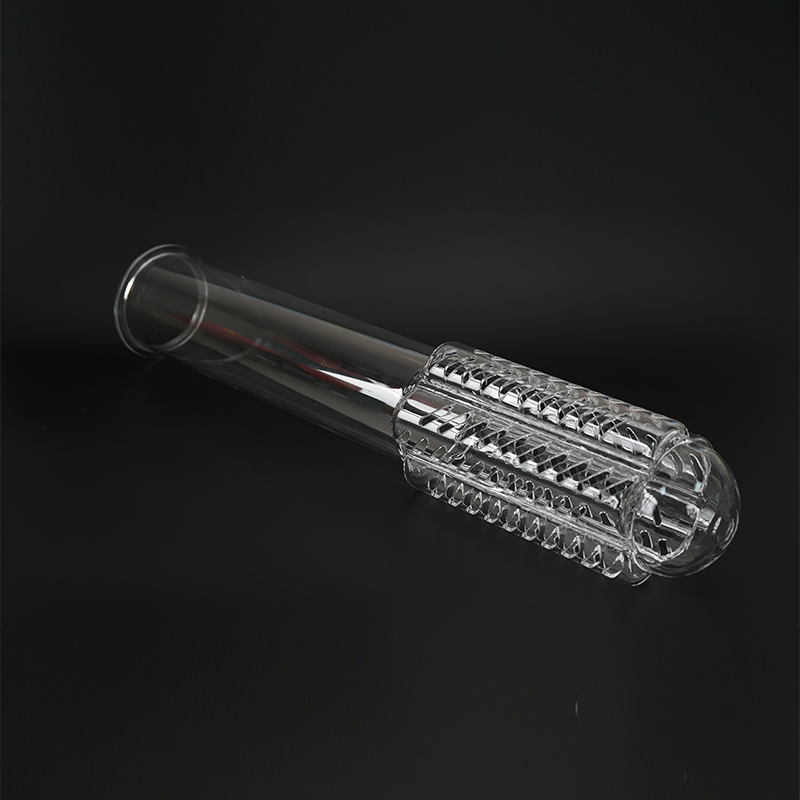
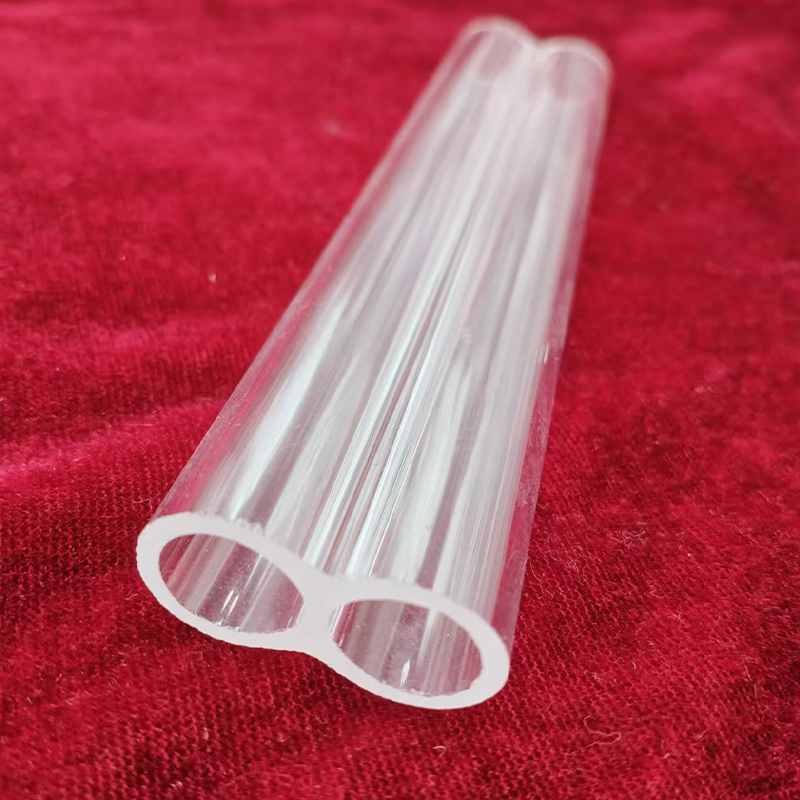
The radar chart powerfully illustrates the asymmetric performance profiles of the two materials. The fused quartz polygon (solid blue) extends close to the outer boundary of the chart on six of eight axes — temperature resistance, UV transmission, purity, thermal shock resistance, dimensional stability, and optical clarity — while the borosilicate polygon (dashed) is compact in all directions except formability and optical clarity at visible wavelengths. The formability axis is where borosilicate shows its practical advantage: a score of 9/10 versus quartz's 5/10 reflects the ease with which standard borosilicate can be flame-worked into complex shapes by a laboratory glassblower, enabling products like custom triangular shaped funnel, bell glass dome, and round multiuse glass vessels to be fabricated on-site without specialist high-temperature equipment. The quartz formability limitation is addressed by Yancheng Mingyang's dedicated secondary processing capabilities, which extend the quartz product range to include quartz glass tube bends, spherical forms, U-tubes, double-bore tubes, and custom special-shaped quartz glass for applications that require quartz's thermal and optical properties in non-standard geometries. For optical clarity at visible wavelengths, both materials score similarly (quartz 9.5, borosilicate 9), confirming that for visible-light applications such as laboratory vessels, observation windows, and glass water bottle for restaurant display applications, borosilicate is a functionally adequate and commercially practical choice.
Application Decision Matrix: When to Choose Each Material
The horizontal bar chart below summarizes the material suitability scores for each of ten major application categories, providing a rapid visual reference for procurement decisions. Scores reflect the combined weighting of temperature, UV, purity, and formability requirements for each application.
The suitability bar chart reveals a clear application boundary between the two materials. For the top five application categories — semiconductor furnaces, UV lamps, high-temperature chemical reactors, infrared heater tubes, and laboratory crucibles — fused quartz scores 9 to 10 while borosilicate scores 0 to 4, confirming that these applications are essentially quartz-only domains. The quartz crucible, laboratory quartz crucible, opaque fused silica crucible, and high purity heat resistant fused quartz glass boat product family sit firmly in the quartz domain because of the 1100°C-plus operating temperatures involved in crystal growth, CVD, and chemical digestion procedures. At the moderate-temperature end, the chart shows a crossover point at optical instrument windows, where quartz remains preferable for UV-sensitive instruments but borosilicate becomes viable for visible-light systems. For foodservice and display glassware applications — glass water bottle for restaurant, bell glass dome, and similar — borosilicate scores 9.5, reflecting its excellent combination of thermal shock resistance for hot-fill applications, optical clarity, and practical formability that allows decorative shapes and custom geometries at reasonable cost. These are applications where the superior properties of fused quartz provide no functional benefit and borosilicate is the sensible commercial choice.
Extended Application Coverage: Sound Healing, Optical, and Specialty Products
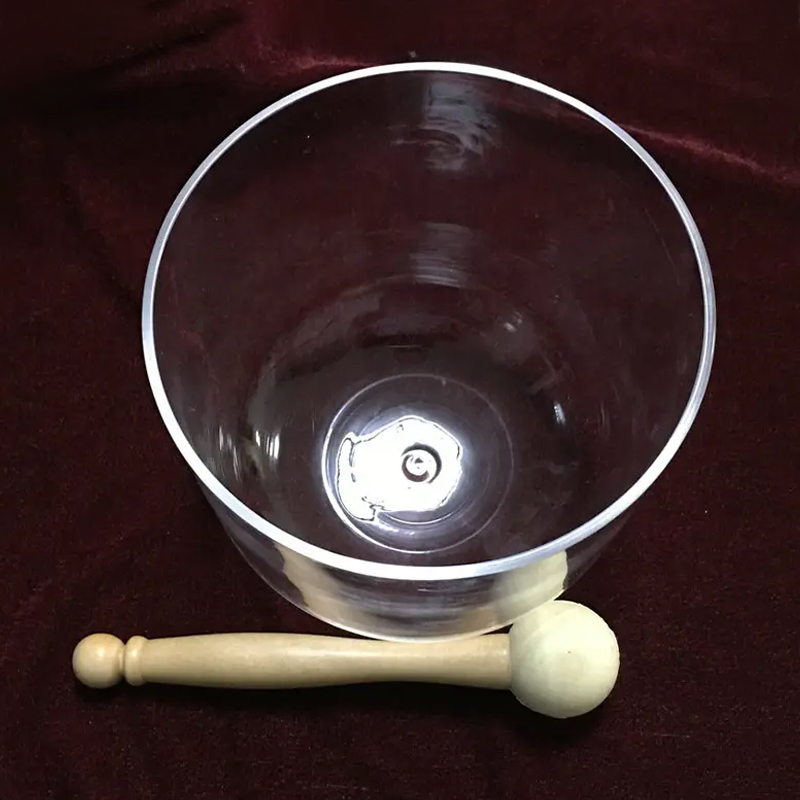
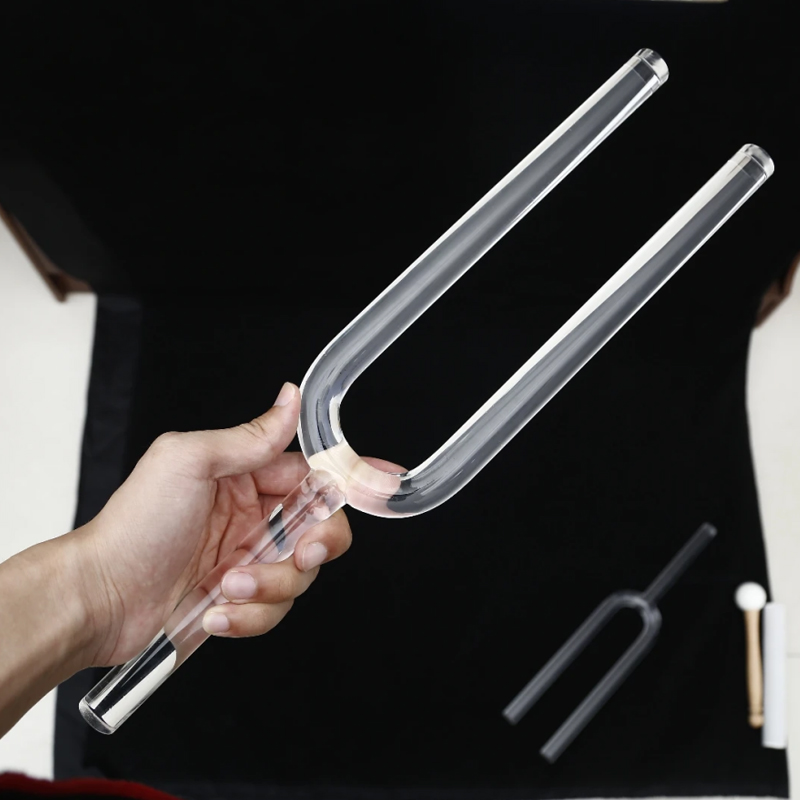
Beyond industrial and laboratory applications, high-purity quartz glass has a growing role in sound healing and resonance instruments. Crystal Alchemy Bowls, crystal singing bowl, Quartz Crystal Tuning Fork, Crystal Singing Triangle, Crystal Harp, and Crystal Singing Holy Grail instruments are all fabricated from high-purity fused quartz, leveraging the material's acoustic resonance properties — specifically its very high Q-factor (quality factor) that enables sustained, pure-tone vibration. The same material purity (SiO2 above 99.9%) that makes quartz ideal for semiconductor processing also produces exceptionally clear, sustained tones when the material is formed into bowls, rods, or tuning fork geometries and excited by a mallet or bow.
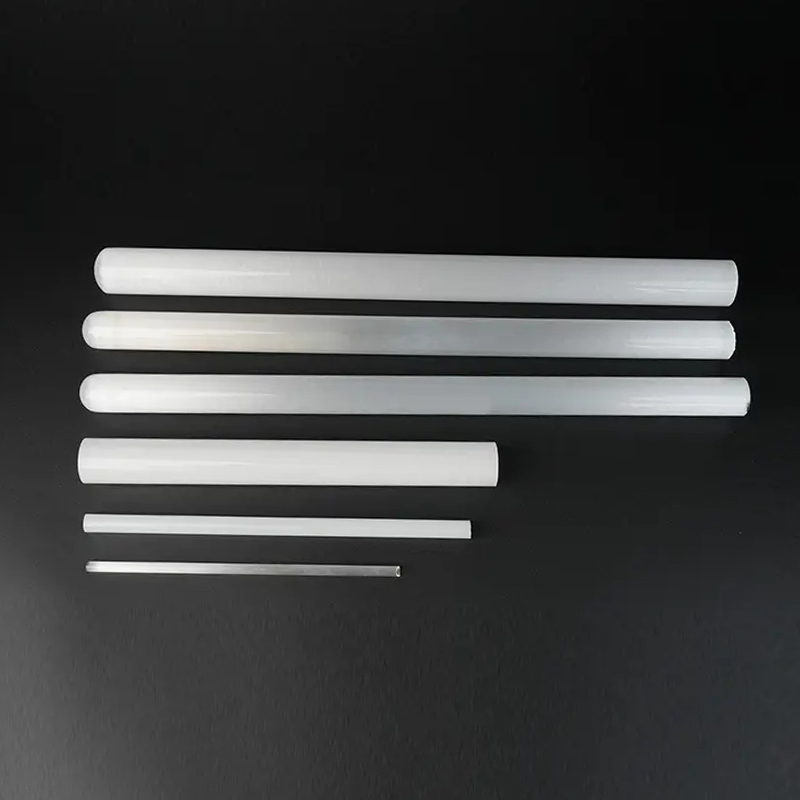
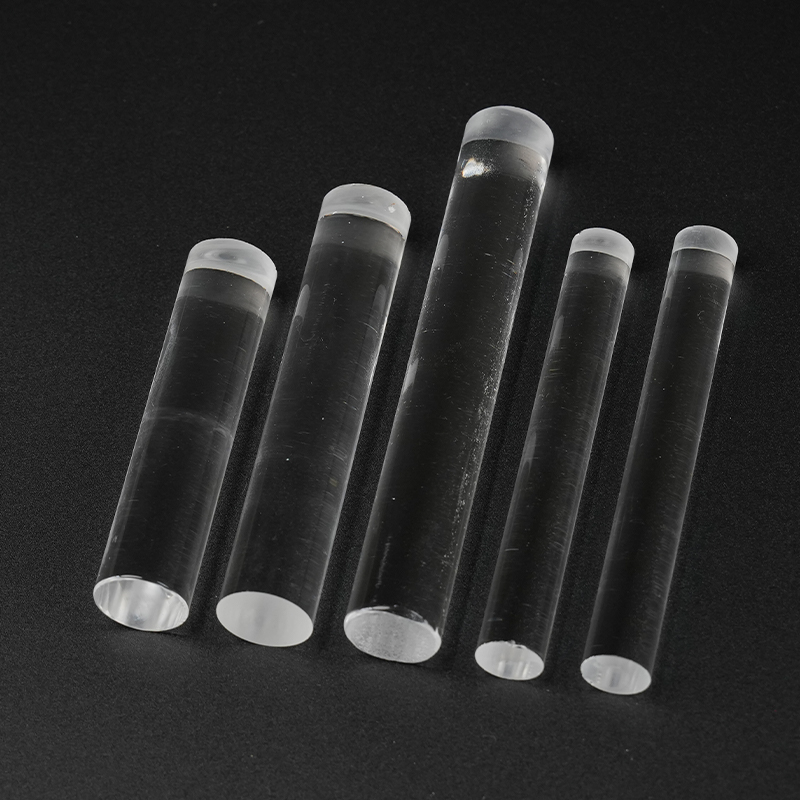
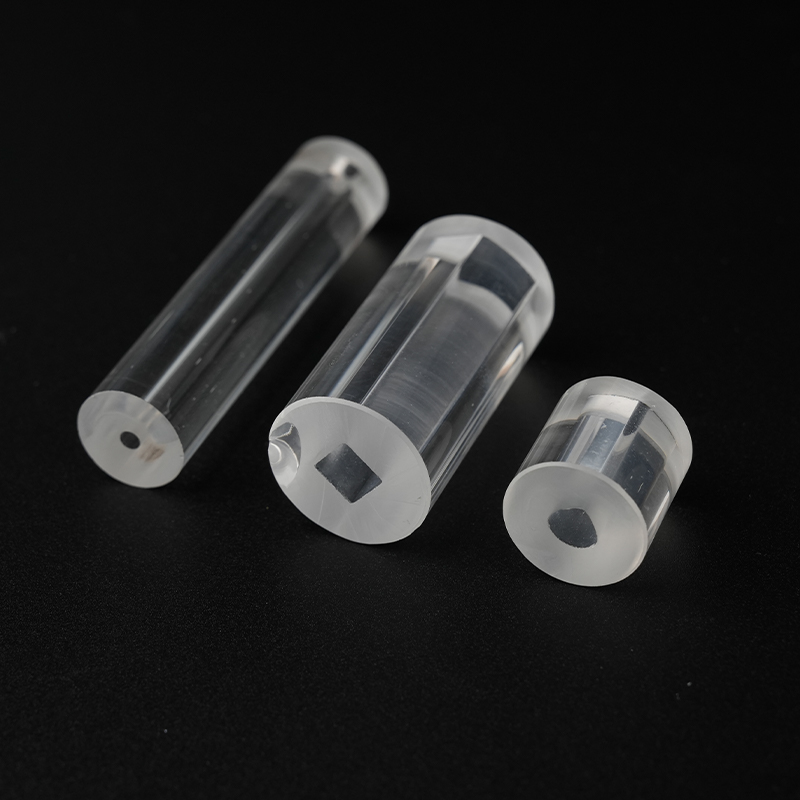
Specialty optical products including UV Fused Quartz Cuvettes, quartz cuvette rectangular formats, UV Quartz Plate, and UV Round Quartz Plate With Holes serve spectroscopy and photolithography applications where both UV transmission and dimensional accuracy to optical tolerances (surface flatness below lambda/4) are required simultaneously. Fused Quartz Rods and quartz crystal rods serve as optical delay lines, laser gain medium supports, and precision measurement references. The quartz glass rod and quartz glass sheet product forms complement the quartz tube range by providing solid and planar geometries for applications where a tube bore is not needed. Quartz glass window panels and special optical glass components complete the portfolio for vacuum chamber viewports, laser entrance windows, and high-pressure observation cells.
About Yancheng Mingyang Quartz Products Co., Ltd.
Yancheng Mingyang Quartz Products Co., Ltd. is a company specializing in the production of quartz and special glass products, and is the production plant of Jinzhou Mingde Quartz Glass Co., Ltd. in Jiangsu Province. Since its establishment, the company has developed rapidly, introducing advanced technology and production equipment from both domestic and international sources, continuously improving product quality. As a professional custom Quartz Glass Tube Supplier and Glass Pipe Factory, the company has developed a variety of products suited to the market, meeting the needs of diverse customers and solving many urgent production challenges for its global client base.
The company's product portfolio includes quartz glass tubes, double-hole quartz glass tubes, quartz glass rods, quartz sheets, sapphire windows, calcium fluoride glass windows, infrared ultraviolet coatings, high-pressure resistant aluminosilicate glass window panels, quartz glass instruments, high borosilicate glass instruments, quartz crucibles, quartz gold-plated tubes, quartz heaters, quartz infrared heating tubes, far-infrared directional radiation heaters, ultraviolet germicidal lamps, and other special types of quartz glass products. Products are exported to Europe, America, Japan, South Korea, and other international markets.
Frequently Asked Questions
Featured Products
Copyright © Yancheng Mingyang Quartz Products Co., Ltd. All Rights Reserved.
Wholesale Quartz Products Manufacturer Quartz Glass Factory