

 +86-0515-86223369
  0
0 en
en English
 日本語
日本語 Español




If you need any help, please feel free to contact us
 Products & Solutions
Quartz Glass Sheet vs Quartz Glass Window: Types & Uses
Content
- 1 Quartz Glass Sheet and Quartz Glass Window: Direct Answer and Core Differences
- 2 Common Types and Characteristics of Quartz Glass Sheet and Window Products
- 3 Manufacturing Principle and Structure of a Quartz Glass Sheet or Window
- 4 Where Window Materials Are Used: Application Distribution
- 5 Transmission Range: Quartz Glass Window Versus Standard Glass
- 6 Pressure Resistance: Quartz Glass Window Versus Aluminosilicate Panel
- 7 Thickness and Operating Temperature: What the Data Shows
- 8 Application Scenarios and Selection Guidelines
- 9 Detailed Comparison of Quartz Glass Window and Related Window Materials
- 10 Maintenance, Handling, and Storage Guidance
- 11 Manufacturing Capability and Sourcing Quartz Glass Sheet and Window as a B2B Buyer
- 12 Frequently Asked Questions About Quartz Glass Sheet and Quartz Glass Window
- 12.1 Q1: What is the difference between a quartz glass sheet and a quartz glass window?
- 12.2 Q2: What thickness and size options are typically available for quartz glass sheet?
- 12.3 Q3: Is a quartz glass window suitable for high-pressure equipment?
- 12.4 Q4: Can a quartz glass window be coated for specific wavelength performance?
- 12.5 Q5: How does a quartz glass window compare to a sapphire or calcium fluoride window?
Quartz Glass Sheet and Quartz Glass Window: Direct Answer and Core Differences
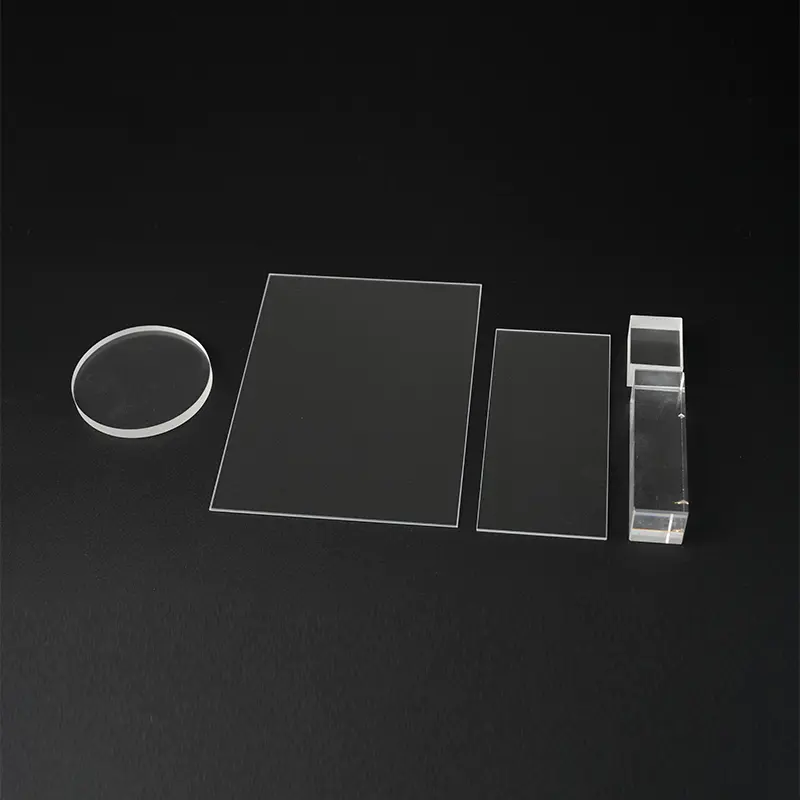
A quartz glass sheet is a flat piece of fused silica material supplied in a range of thicknesses and sizes, generally used either as raw stock for further fabrication or directly as a viewing or process surface. A quartz glass window is a quartz glass sheet that has been cut, edge-finished, and often coated or mounted to a defined specification so that it can be installed into equipment where a sealed, optically consistent viewing or transmission path is required. In short, every quartz glass window begins as a quartz glass sheet, but not every quartz glass sheet is finished to window specification, and this distinction is the first thing a buyer should clarify before requesting a quote.
Choosing between sheet stock and a finished window depends on how the part will be used. A laboratory fabricator that will cut and polish its own parts generally purchases quartz glass sheet in bulk sizes. An equipment builder installing a sight glass, a process viewport, or a UV transmission window generally purchases a quartz glass window that already meets thickness, flatness, and edge-finish requirements. Both product forms are produced from the same base fused silica material family used across quartz glass tube, quartz crucible, and quartz glass rod product lines, and a single quartz glass products manufacturer commonly supplies all of these forms from one production facility.
This article reviews the common types of quartz glass sheet and quartz glass window products, explains how they are structured and manufactured, outlines application scenarios and selection guidelines, compares quartz glass windows against related window materials such as sapphire and calcium fluoride, provides maintenance guidance, and closes with frequently asked questions from laboratory, optical, and industrial buyers. Data visualizations are included throughout to illustrate typical usage patterns, transmission behavior, pressure resistance, and thickness-related performance so that technical buyers can compare options based on measurable characteristics.
Key takeaway: a quartz glass window is a quartz glass sheet finished to a defined thickness, flatness, and edge specification for direct installation, while raw sheet stock is generally purchased for further fabrication.
Common Types and Characteristics of Quartz Glass Sheet and Window Products
Quartz glass sheet and quartz glass window products are generally grouped by transparency, coating, and edge treatment. A clear fused quartz glass sheet is fully transparent and is the most common base stock for windows, plates, and further-machined components. A frosted or ground-finish quartz glass sheet has a matte surface on one or both faces and is typically selected where light diffusion rather than direct transmission is desired. A UV-grade quartz glass window is produced and, where required, coated to maintain transmission further into the ultraviolet range, and this variant is closely related to the UV Quartz Plate and UV Round Quartz Plate With Holes product lines used in analytical instruments. An infrared and ultraviolet coated quartz glass window carries a thin functional coating layer applied to adjust reflection or transmission at specific wavelength bands, which is relevant for heater viewing ports and optical filter assemblies. Beyond quartz-specific variants, the same manufacturer typically also offers related but distinct window materials, including sapphire windows, calcium fluoride glass windows, and high-pressure resistant aluminosilicate glass window panels, each suited to different transmission or pressure requirements.
Sheet Stock Variants
|
Finished Window Variants
|
The horizontal card row below summarizes five common configurations that a quartz glass sheet manufacturer typically lists for B2B buyers, giving a quick reference before reviewing thickness and transmission specifications in later sections.
Clear Quartz Glass Sheet
Transparent flat stock for general fabrication and viewing use. Frosted Quartz Glass Sheet
Matte finish for diffusion and non-direct viewing applications. UV-Grade Quartz Glass Window
Edge-finished window for UV and analytical instrument systems. Coated Quartz Glass Window
Infrared or ultraviolet coating layer for targeted wavelength control. High-Pressure Window Panel
Aluminosilicate glass panel rated for pressure-resistant viewports.
Key takeaway: surface finish, coating, and edge treatment define whether a quartz glass sheet functions as raw fabrication stock or as an installation-ready quartz glass window.
Manufacturing Principle and Structure of a Quartz Glass Sheet or Window
Quartz glass sheet production begins with high purity quartz raw material that is melted at high temperature and formed into a flat slab or plate, either through casting or a rolling-type forming process, before being annealed to relieve internal stress. Once the base slab is stable, it is cut to the target sheet size, and the faces are ground and polished to the required flatness and surface finish. When a sheet is finished into a quartz glass window, the edges are typically ground to a defined profile so the part can be sealed or mounted into a housing, and an infrared or ultraviolet coating may be applied to one or both faces depending on the target wavelength performance. The internal structure of the finished sheet is amorphous rather than crystalline, which is the same structural characteristic shared with quartz glass rod and quartz glass tube products, and it is a primary reason the material tolerates thermal cycling without the directional stress behavior seen in crystalline window materials such as sapphire.
The diagram below is a labeled structural illustration of a typical coated quartz glass window, showing the flat body, the ground edge profile, and the optional coating layer that separates a basic quartz glass sheet from an installation-ready window component.
Sheet width, length, and thickness are the primary dimensions specified when ordering, while flatness tolerance and edge profile become additional requirements once a sheet is finished into a window. A quartz glass sheet supplier generally quotes thickness in standard increments and can grind or cut to a custom size on request, while a quartz glass window order typically also specifies coating type, edge chamfer, and sometimes a mounting tolerance for the target housing. These structural details set up the transmission and pressure performance topics covered in the following sections.
Key takeaway: the step from quartz glass sheet to quartz glass window mainly adds edge-profile finishing and, where required, a functional coating layer.
Where Window Materials Are Used: Application Distribution
Different window materials are matched to different application categories based on transmission range and pressure requirements rather than being interchangeable by default. UV and optical systems generally favor quartz glass windows and calcium fluoride glass windows because of their transmission characteristics into the ultraviolet and, for calcium fluoride, further into the infrared range. High-pressure viewing ports on process equipment more often specify high-pressure resistant aluminosilicate glass window panels because of their mechanical strength under differential pressure. Industrial and infrared heating windows, including those used alongside Halogen Heater Infrared and Far Infrared Quartz Tube Heater assemblies, are generally dominated by quartz glass window material because of its thermal stability. Before reviewing the stacked bar chart below, note that each bar represents one application category and the colored segments within it represent the approximate share of each window material typically specified for that category.
The stacked bar chart shows that quartz glass material forms the largest single segment in both the UV and optical category and the industrial and infrared heating category, which reflects its broad transmission range and thermal stability across those use cases. In the high-pressure viewing port category, the chart shows aluminosilicate glass forming the largest segment, illustrating that mechanical pressure resistance rather than transmission range is the primary selection driver for that application. Calcium fluoride appears as a meaningful but smaller segment in the UV and optical category, consistent with its selective use where transmission further into the infrared is required alongside ultraviolet performance. Sapphire appears as a smaller segment across categories, generally reserved for applications where its mechanical hardness or specific optical properties justify its use over quartz glass. The industrial and infrared heating category shows almost no aluminosilicate, sapphire, or calcium fluoride share in this illustrative breakdown, which lines up with quartz glass window material being the practical default for heater viewing ports and infrared transmission windows. This pattern is useful for buyers because it shows that material selection tends to cluster by application category rather than being evenly distributed across all window types. A quartz glass window supplier serving equipment builders across several industries typically stocks material for all four categories shown, since a single buyer may need both a UV-grade quartz glass window and a high-pressure aluminosilicate panel for different parts of the same piece of equipment. For laboratory customers combining a UV Quartz Plate with a Quartz Cuvette Rectangular in the same optical path, the dominance of quartz glass in the UV and optical segment is directly relevant to component selection. For process engineers specifying a viewport on pressurized equipment, the chart is a reminder to prioritize aluminosilicate or another pressure-rated material over standard quartz glass sheet stock. Overall, the distribution shown reinforces that application category, not general material preference, should guide the choice between quartz glass, aluminosilicate, sapphire, and calcium fluoride window materials.
Key takeaway: quartz glass windows dominate UV, optical, and infrared heating applications, while high-pressure viewing ports more often specify aluminosilicate glass window panels.
Transmission Range: Quartz Glass Window Versus Standard Glass
Transmission range describes the span of wavelengths a window material allows to pass through with limited loss, and it is one of the most important specifications for any UV, visible, or infrared optical path. Standard glass windows generally transmit well across the visible spectrum but drop off sharply once wavelength moves into the ultraviolet region, which limits their use in UV instrumentation. Quartz glass window material is widely recognized for maintaining useful transmission from the ultraviolet region through the visible spectrum and into part of the near-infrared range, which is why it is specified for UV Fused Quartz Cuvettes, UV Quartz Plate, and general optical instrument windows rather than standard glass. Before reviewing the area chart below, note that the shaded area under each line represents the approximate wavelength range over which that material maintains useful transmission, so a larger shaded area indicates a broader usable range. The chart compares a quartz glass window against a standard glass window across the same wavelength axis.
The area chart shows the quartz glass window shaded region extending across nearly the full wavelength axis, while the standard glass window shaded region only begins further to the right, after the material's transmission rises out of the ultraviolet cutoff zone. This visual difference represents the practical reason quartz glass window material is specified whenever an instrument needs to detect or transmit ultraviolet wavelengths, since standard glass simply blocks a meaningful portion of that range. The gap between the two shaded areas on the left side of the chart corresponds to the ultraviolet region, where standard glass transmission drops sharply while quartz glass transmission remains comparatively stable. In the visible and near-infrared region on the right side of the chart, both materials show broadly similar shaded coverage, which is why standard glass remains an acceptable and common choice for applications that do not require ultraviolet transmission. This distinction is directly relevant to UV Quartz Plate and UV Round Quartz Plate With Holes products, which are specifically manufactured to preserve this extended ultraviolet transmission range for analytical and testing equipment. It is equally relevant to Quartz Cuvette Rectangular components used in spectroscopy, where accurate ultraviolet transmission is central to measurement accuracy. For general viewing windows on equipment that only needs to be observed under visible light, a standard glass panel may be entirely adequate, and specifying a quartz glass window in that case would not meaningfully change functional performance. For any application involving ultraviolet exposure, germicidal lamp systems, or ultraviolet coating processes, the extended range shown in the chart is the primary technical justification for selecting quartz glass window material over standard glass. Buyers sourcing a quartz glass sheet manufacturer for a UV-sensitive project should confirm the specific transmission curve for the exact grade being quoted, since UV-grade and standard-grade quartz glass window products can differ somewhat within the broader quartz glass family. Overall, transmission range is the clearest technical differentiator between quartz glass window material and standard glass for any optical or ultraviolet-sensitive application.
Key takeaway: quartz glass window material maintains useful transmission into the ultraviolet range where standard glass does not, making it the practical choice for UV-sensitive optical paths.
Pressure Resistance: Quartz Glass Window Versus Aluminosilicate Panel
Pressure resistance describes how much differential pressure a window can withstand before the risk of mechanical failure becomes a design concern, and it is a separate consideration from transmission range or thermal performance. High-pressure resistant aluminosilicate glass window panels are specifically manufactured with this requirement in mind and are generally rated for a higher relative pressure tolerance than a standard-thickness quartz glass window of comparable size. Standard quartz glass window material still offers reasonable mechanical strength for general laboratory and instrument use, but it is not typically the first choice for a viewport on equipment operating under significant internal or external pressure differential. Before reviewing the gauge chart below, note that each gauge shows a relative pressure resistance rating on a common illustrative scale, allowing a side-by-side comparison of the two window materials without implying a specific numeric pressure certification. The two gauges compare a standard quartz glass window against a high-pressure resistant aluminosilicate glass window panel.
The gauge chart shows the high-pressure resistant aluminosilicate glass window panel positioned notably higher on the relative rating scale than the standard quartz glass window, which visually reinforces why aluminosilicate panels are the more common specification for pressure-critical viewports. This does not mean quartz glass window material is unsuitable for all pressure-related use, since many laboratory and instrument applications operate at or near atmospheric pressure, where the lower relative rating shown for quartz glass is not a functional limitation. The gap between the two gauges becomes more relevant as differential pressure increases, which is why equipment builders working with sealed chambers, pressurized process lines, or vacuum systems generally default to an aluminosilicate panel rather than standard sheet-derived quartz glass. It is worth noting that both materials shown in the chart still originate from a manufacturer capable of producing quartz glass sheets, quartz glass windows, and high-pressure resistant aluminosilicate glass window panels within the same broader special glass product range. For laboratory customers whose equipment does not involve significant pressure differential, prioritizing transmission range and thermal stability, as covered in earlier sections, remains more relevant than the pressure comparison shown here. For industrial customers designing viewports on pressurized reactors, mixing vessels, or process piping, the gauge comparison is a practical starting point for discussing panel thickness and material grade with a supplier. Buyers should also recognize that increasing the thickness of a standard quartz glass window can improve its practical pressure tolerance to some degree, though this typically does not close the full gap shown between the two materials at comparable thickness. When both transmission range and pressure resistance matter for the same viewport, some equipment designs use a layered or dual-window approach, pairing a quartz glass window for optical performance with a structural aluminosilicate or reinforced panel for pressure containment. Discussing the intended operating pressure range with a quartz glass window supplier early in a project generally leads to a more efficient specification process than selecting a material first and validating pressure tolerance afterward. Overall, the gauge comparison illustrates that pressure resistance, not transmission range, is the deciding factor when aluminosilicate glass window panels are specified over standard quartz glass windows.
Key takeaway: high-pressure resistant aluminosilicate glass window panels carry a materially higher relative pressure rating than standard quartz glass windows, making them the practical choice for pressurized viewports.
Thickness and Operating Temperature: What the Data Shows
Buyers frequently ask whether a thicker quartz glass sheet or window can tolerate a higher operating temperature than a thinner one, and the practical answer is that thickness has a limited effect on the maximum operating temperature for fused quartz material specifically, because the temperature limit is primarily a property of the base material rather than the part geometry. This differs from some other window materials, where thickness and thermal mass can meaningfully change practical operating limits. Before reviewing the scatter plot below, it helps to understand that each point represents one product variant plotted by its thickness on the horizontal axis and its typical maximum operating temperature on the vertical axis. Two series are shown, one for quartz glass sheet and window variants and one for aluminosilicate window panel variants, so that the thickness-temperature relationship can be compared across material types. The scatter plot below illustrates this relationship across a representative thickness range.
The scatter plot shows the quartz glass sheet and window data points forming a nearly flat, high band across the full thickness range tested, which visually confirms that increasing thickness does not substantially raise the maximum operating temperature for fused quartz material. This flat pattern is consistent with the earlier discussion of fused quartz softening point and thermal expansion, since both properties are intrinsic to the material composition rather than the part dimensions. The aluminosilicate panel data points sit noticeably lower on the vertical axis across all thickness values shown, and the series shows a gradual upward trend as thickness increases, indicating that for aluminosilicate material, added thickness does provide some incremental improvement in practical high-temperature tolerance. This contrast is useful for buyers because it shows that thickness selection should be driven by different priorities depending on material: for quartz glass sheet and window products, thickness is generally chosen based on mechanical rigidity and pressure needs rather than temperature performance, while for aluminosilicate panels, thickness can be a relevant lever for both mechanical and thermal performance. For a quartz glass window installed on a Halogen Heater Infrared or Far Infrared Quartz Tube Heater assembly, this means selecting a thickness sufficient for structural mounting and handling durability, since the temperature tolerance itself is already high across the typical thickness range offered. For an aluminosilicate viewport on a high-temperature pressurized process line, both thickness and material grade become relevant variables to discuss with a supplier. Buyers evaluating a quartz glass sheet manufacturer for a heating equipment project can generally simplify their specification conversation by focusing on thickness for mechanical fit rather than temperature margin, since the temperature performance is consistently high across the product range. This scatter comparison also explains why some equipment designs mix material types, using a thin quartz glass window for the primary optical or thermal path and a thicker aluminosilicate panel where structural pressure containment is the dominant requirement. Overall, the data pattern shown reinforces that quartz glass sheet and window thickness selection should be guided primarily by mechanical and dimensional requirements rather than by an expectation of significantly changing thermal performance.
Key takeaway: quartz glass sheet and window operating temperature stays consistently high across typical thickness ranges, so thickness selection should be based on mechanical fit rather than expected temperature gains.
Application Scenarios and Selection Guidelines
Laboratory and research settings generally use quartz glass sheet stock for custom-fabricated fixtures and quartz glass windows for sight glasses on furnace or reactor equipment, often alongside laboratory quartz crucible and quartz glass tube components in the same setup. Semiconductor and electronics manufacturing relies on high purity quartz glass sheet and window material for process viewing ports where chemical inertness and dimensional stability matter under repeated thermal cycling. Optical and ultraviolet systems pair quartz glass windows with UV Quartz Plate, UV Round Quartz Plate With Holes, and UV Fused Quartz Cuvettes components to maintain a consistent transmission path across an instrument. Industrial and infrared heating equipment uses quartz glass windows as viewing or transmission ports on Halogen Heater Infrared and Carbon Fiber Quartz Heater assemblies. High-pressure or vacuum equipment typically specifies high-pressure resistant aluminosilicate glass window panels instead of standard quartz glass sheet stock, based on the pressure comparison discussed earlier in this article.
Application Scenarios
|
Selection Checklist
|
Buyers sourcing from a quartz glass window wholesaler for repeat production generally submit a specification covering thickness, transmission requirement, and edge finish before requesting a sample, which reduces the likelihood of mismatched parts once full production begins. For projects that combine several related quartz components, such as a quartz glass window alongside a High Purity Quartz Glass Tube or a High Purity Heat Resistant Fused Quartz Glass Boat, confirming that all parts are sourced to compatible purity grades helps maintain consistent performance across the assembly.
Key takeaway: match transmission range, thickness, and pressure requirements to the application before finalizing whether raw sheet stock or a finished window is the correct order.
Detailed Comparison of Quartz Glass Window and Related Window Materials
Because quartz glass sheet and window products are frequently compared against sapphire, calcium fluoride, and aluminosilicate window materials, a side-by-side comparison helps buyers narrow their selection based on transmission range and pressure characteristics.
| Material | Transmission Range | Relative Pressure Rating | Primary Application |
|---|---|---|---|
| Quartz Glass Sheet | UV to near-infrared | Moderate | Fabrication stock, general viewing |
| Quartz Glass Window | UV to near-infrared | Moderate | Instrument and heater viewing ports |
| Sapphire Window | UV to mid-infrared | High | High-hardness optical windows |
| Calcium Fluoride Window | UV to far-infrared | Moderate | Wide-band infrared optical systems |
| Aluminosilicate Window Panel | Visible range | Very High | Pressure-rated viewports |
This comparison shows that quartz glass sheet and quartz glass window products occupy a practical middle position, offering broad transmission range with moderate pressure resistance, while sapphire and aluminosilicate trade some transmission breadth for higher mechanical or pressure performance, and calcium fluoride extends transmission further into the infrared. A quartz glass products manufacturer that also produces sapphire windows, calcium fluoride glass windows, and aluminosilicate window panels can generally support a buyer who needs to compare more than one material for the same application.
Key takeaway: quartz glass window material offers a broad, balanced transmission range, while sapphire, calcium fluoride, and aluminosilicate materials are selected when a specific transmission or pressure requirement falls outside that balance.
Maintenance, Handling, and Storage Guidance
Quartz glass sheet and quartz glass window products generally require straightforward but consistent care to preserve transmission clarity and edge integrity over their service life. Cleaning should be performed with a soft, lint-free cloth and a mild, non-abrasive cleaning solution, since abrasive materials or rough handling can scratch a polished face and reduce optical transmission over time. Coated quartz glass windows should be cleaned with particular care around the coated face, since some coating layers are more sensitive to abrasion than the base fused quartz surface beneath them. Sudden temperature change should be avoided where possible, allowing a heated window to cool gradually rather than being exposed to a cold surface or liquid immediately after use, since rapid temperature swings increase the risk of stress cracking even in low-expansion fused quartz material. Edge protection during handling and storage is particularly important for finished windows, since a chip along the ground edge profile can compromise a sealed installation even if the main viewing area remains undamaged.
- Clean with a soft, non-abrasive cloth and mild solution only.
- Allow heated sheets or windows to cool gradually before handling.
- Store sheets and windows vertically in padded racks or slots.
- Protect edges and coated faces from direct contact during transport.
- Inspect edge seals and coatings periodically for wear or chipping.
Key takeaway: gradual temperature transitions and careful edge protection are the two habits most likely to extend the useful life of a quartz glass sheet or window.
Manufacturing Capability and Sourcing Quartz Glass Sheet and Window as a B2B Buyer
For B2B buyers evaluating a quartz glass sheet manufacturer or quartz glass window supplier, production capability across related window materials matters as much as the specification sheet for a single product, since many projects end up needing more than one window type from the same source. Yancheng Mingyang Quartz Products Co., Ltd. is a company specializing in the production of quartz and special glass products, and it operates as the production plant of Jinzhou Mingde Quartz Glass Co., Ltd. in Jiangsu. Since its establishment, the company has introduced production technology and equipment and has continued refining product quality across its quartz glass sheet, quartz glass window, and related product lines. The company's product range includes quartz glass tubes, double-hole quartz glass tubes, quartz glass rods, quartz sheets, sapphire windows, calcium fluoride glass windows, infrared and ultraviolet coatings, high-pressure resistant aluminosilicate glass window panels, quartz glass instruments, high borosilicate glass instruments, quartz crucibles, quartz gold-plated tubes, quartz heaters, quartz infrared heating tubes, and far-infrared directional radiation heaters, alongside ultraviolet germicidal lamp components and other special quartz glass products.
This combination of product lines is relevant to buyers because a single quartz glass products manufacturer that also produces sapphire windows, calcium fluoride glass windows, and aluminosilicate window panels can support a project that requires comparing several window materials for the same piece of equipment, rather than requiring separate suppliers for each option. For laboratory customers, this can mean sourcing quartz glass sheet stock alongside a laboratory quartz crucible from a single production plant. For equipment builders, it can mean discussing whether a standard quartz glass window or a high-pressure aluminosilicate panel is the better fit for a specific viewport with a supplier that manufactures both. When evaluating a manufacturer or wholesaler for a bulk quartz glass sheet or window order, buyers are generally well served by requesting sample pieces, confirming thickness and transmission requirements in writing, and clarifying edge-finish and coating specifications before committing to a full production run.
Key takeaway: a manufacturer producing quartz glass sheet, quartz glass window, sapphire, calcium fluoride, and aluminosilicate window panels from one facility can simplify sourcing for projects that compare multiple window materials.
Frequently Asked Questions About Quartz Glass Sheet and Quartz Glass Window
Q1: What is the difference between a quartz glass sheet and a quartz glass window?A quartz glass sheet is generally flat stock supplied for further fabrication, while a quartz glass window is a sheet that has been cut, edge-finished, and sometimes coated to a defined specification for direct installation into equipment. |
Q2: What thickness and size options are typically available for quartz glass sheet?Quartz glass sheet is generally available across a range of standard thicknesses and sizes, and most manufacturers can also cut, grind, and polish sheets to a custom specification for a specific window or fixture project. |
Q3: Is a quartz glass window suitable for high-pressure equipment?A standard quartz glass window offers moderate pressure resistance suitable for many laboratory and instrument uses, but equipment operating under significant pressure differential generally specifies a high-pressure resistant aluminosilicate glass window panel instead. |
Q4: Can a quartz glass window be coated for specific wavelength performance?Yes, an infrared or ultraviolet coating can typically be applied to one or both faces of a quartz glass window to adjust transmission or reflection at specific wavelength bands based on the target instrument requirement. |
Q5: How does a quartz glass window compare to a sapphire or calcium fluoride window?A quartz glass window offers a broad, balanced transmission range with moderate pressure resistance, while sapphire generally provides higher mechanical hardness and calcium fluoride extends transmission further into the infrared, so the choice depends on the specific transmission or durability requirement. |
Featured Products
Copyright © Yancheng Mingyang Quartz Products Co., Ltd. All Rights Reserved.
Wholesale Quartz Products Manufacturer Quartz Glass Factory